Welcome Guys

Showing posts with label Our Planet and Sun. Show all posts

How Science is Improving Our Understanding of Nature

Written By esperanza on Tuesday, November 22, 2011 | 11:21 PM

For centuries, scientists have engaged in research that has increased our understanding of nature and how natural forces work to create and sustain the world and universe we see today. The purpose of science is to follow a process of making careful and unbiased observations in order to generate knowledge about the world through tested theories based on the scientific observations. Although theories may not guarantee the absolute truth about a particular scientific theory, the idea is to get as close to an accurate approximation of the truth. The result will lead to a more accurate and credible understanding of how the natural world works.

Scientists seek to learn as much as possible about the nature of the world. By using intellect, the aid of scientific study devices, and formulated scientific hypothesis, scientists now have a better understanding of nature. For instance, the principles of motion and the law of gravity are applicable when studying other parts of the universe, even if we have yet to travel to these areas. The same principles can be applied to other forces such as seeking to understand ocean tides, bird migrations, earthquakes, and hurricanes. Scientists study patterns both in the natural world and in laboratories using technologically advanced research devices to gather data, take measurements, and make their observations and create their scientific theories. The result is an improved understanding of nature.

Science also helps us understand how we evolved. By studying such elements as fossils of species that once roamed the earth millions of years ago, various rocks and other matter located deep within the earth, skeletal remains of dinosaurs, and the remains of prehistoric man and early primates, scientists have made many significant discoveries about how we evolved. In fact, such famous scientists as Stephen Hawking, Carl Sagan, Albert Einstein, and Charles Darwin, have all contributed important theories and data that have brought us even closer to understanding how the universe emerged and developed.

How science has reconstructed the events in the history of the planet and its life forms have led to remarkable improvements and insight into how nature works. For instance, by studying the contours of the ocean floors, the shape of continents, the effects of a volcano eruption and earthquake, and where different fossils have been found, we get a better understanding of why our continents reside where they are and how human populations and species migrated and evolved to what we see today. We also get a better understanding of the results of the ice age and the effect it had on the types of species we have today. Understanding how the world evolved and the changes that took place also helps us to better understand current world problems such as the effects of Global Warming which is essential to finding ways to slow it down. By understanding how nature and its natural forces work, we are better able to come up with ways to manage the planet and its inhabitants.

Because science relies heavily on accurate and unbiased data, there is a constant development of advanced techniques and instruments which has lead to many astounding discoveries in the world and universe. For instance, the Hubble Telescope has resulted in many astounding discoveries about the stars, planets, black holes, and even far away galaxies. With advanced computer systems and other technologically advanced instrument, the future for scientific discovery looks bright concerning our understanding of the history of the universe and the history of life on earth.
11:21 PM | 0 comments | Read More

How Science Has Changed Our Lives

Written By esperanza on Saturday, November 19, 2011 | 11:58 AM

If we look life 100 years ago, and compare that with the today's life, we will notice that Science has dramatically changed human life. With the dawn of the Industrial Revolution in the 18th century, the effect of Science on human life rapidly changed. Today, science has a profound effect on the way we live, largely through technology, the use of scientific knowledge for practical purposes.

Some forms of scientific inventions have changed our lives entirely. For example the refrigerator has played a major role in maintaining public health ever since its invention. The first automobile, dating from the 1880s, made use of many advances in physics, mathematics and engineering; the first electronic computers emerged in the 1940s from simultaneous advances in electronics, physics and mathematics. Today we have extra high- speed super computers with 100 % accuracy.

Science has enormous influence on our lives. It provides the basis of much of modern technology - the tools, materials, techniques, and sources of power that make our lives and work easier. The discoveries of scientists also help to shape our views about ourselves and our place in the universe.

Research in food technology has created new ways of preserving and flavoring what we eat. Research in industrial chemistry has created a vast range of plastics and other synthetic materials, which have thousands of uses in the home and in industry. Synthetic materials are easily formed into complex shapes and can be used to make machines, electrical, and automotive parts, scientific, technical and industrial instruments, decorative objects, containers, packing materials and many other items.

1: The use of science in daily life has helped us a good deal in solving problems, dealing with the maintenance of health, production and preservation of food, construction of houses and providing communication and trans-portational (related to transport) facilities. With the help of Science we have controlled epidemics and much other kind of diseases. Now we know the basic structure of DNA and Genetic Engineering is conducting research to find out the right and correct Gene Therapy to overcome all the diseases.

2: Science has changed the people and their living, life style, food habits, sleeping arrangements, earning methods, the way of communication between people and recreational activities. All kinds of music systems, computer games, electronic video games, DVDs, cinema entertainment and communication have been brought to our door with the help of Science. The life of man was very different from what it used to be 100 years back. Science has given ears to the deaf, eyes to the blind and limbs to the crippled. Science has adequately, energetically and productively advanced, changed, civilized, enhanced and progressed human life. Science has brought sophistication to human life.

In short science has changed, improved, enhanced, modified and refined human life in all ways.

3: Today with the help of Science we can explain what was strange and mysterious for the people of the past. The Science of Genetics opening new doors of understanding the human gene and cell.

4: Now human beings have become more critical and less fearful than our fore-fathers and ancestors.

5: Two hundred years ago death rate among children was very high. In those days seven out of eight babies died before their first birthday. Now with the help of vaccines, medications and proper health care system life expectancy has improved. Now people live longer and safe lives as compared to 200 years ago. Biochemical research is responsible for the antibiotics and vaccinations that protect us from infectious diseases, and for a wide range of other drugs used to defeat specific health problems. As a result, the majority of people on the planet now live longer and healthier lives than ever before.

6: After that and up to the age of 12 one used to fall in a prey to diseases like small pox, measles, whooping- cough, scarlet fever and diphtheria. Now Science has defeated these diseases.

7: At a later stage again one was under constant threat of yellow fever, malaria, typhus, cholera, typhoid and influenza. Today we have vaccines and medical aid to cope with these health problems. Further research is underway to find out the causes and treatment of these and other diseases.

8: From one person the disease used to spread among the other people. It is called Epidemics. Now with the help of Vaccines and Medications we have defeated these diseases. But still Science has to do more research and has to fight with other arenas of diseases.

9: Life was uncertain. It was rare to see to somebody thirty years old because due to diseases many people died earlier than the age of thirty. These conditions were prevailing just a short while ago.

10: In everyday life, we have to communicate with different friends and relatives, various official people and for general purposes. And many people to be contacted can be at very far off distances. However, time and distance both have been conquered by Science. Whether we want to communicate or travel, both are possible quickly, briskly and expeditiously.

11: These days there are very little chances of babies catching diseases, because births normally take place in hospitals under the supervision of a team of specialist doctors. Science has invented vaccines for young babies to protect them against future life illnesses.

12: Young people are also given medical treatment in time and these days the man lives for about seventy years.

13: Science and scientific methods have helped in finding out the cause of disease and its prevention.

14: Sanitary condition in the past was deplorable. Now we have better sanitary systems.

15: The city streets were unpaved; there was no proper drainage system. Garbage and other refuse was seen everywhere. Pigs were seen wandering through the streets. People got water from filthy wells. Now filtered mineral water is available to overcome diseases. Solid waste management is not a problem now a days, it is the duty of the city municipal committees to manage and dump it with the latest machinery and equipments

16: Now all these defects have gone. There is cleanliness everywhere. It is illegal to throw garbage into the streets. There is a proper drainage system and new and improved methods for solid waste management as it has been told earlier. There are separate departments that bother about sanitary condition of the towns.

17: A century ago for house hold purposes water was carried from wells outside in buckets. It sometimes proved injurious to human health. Moreover, it was insufficient for the daily needs. But now water filters have become a thing of common usage.

18: Now there is sufficient supply of water in cities. For example Los Angeles gets water through pipes from Colorado River, which is 340 miles away. This water is supplied to Los Angeles after the proper water filtration process.

19: With the help of science there is change in our food also. We get varieties of food. In the past, food could not be preserved. But now the quick freezing methods have made possible preservation possible. Due to modern technologies like dehydration and sterilization there is no chance of food poisoning. We get all kinds of fruits, meats and vegetables. Even those fruits and vegetables which are out of season.

20: Not only our eating habits are changed, but also there are improvements in our houses. Means of transport has also undergone a big improvement and change.

21: Science has also changed our attitudes. Superstitions have been discarded, because there is no scientific basis for them. Now people do not fear cloud thunders.

22: Now people no more believe that diseases are caused by evil spirits.

23: Astrology and fortune- telling have lost popularity as compared to 100 years ago. Nobody now fears black cats, broken mirrors and the number 13. Because science has proved that these kinds of fears are un-scientific and illogical.

24: Science has changed the longstanding false notions of the people, which are not supported by Scientific Facts.

25: Research in the field of science and technology has made people open-minded and cosmopolitan, because the Scientist does not like to travel on the beaten track and he always tries to find out new things, new explorations, new discoveries and new inventions.

26: Science has also brought medical equipments that help to save human life. The kidney dialysis machine facilitates many people to survive kidney diseases that would once have proved fatal, and artificial valves allow sufferers of coronary heart disease to return to active living. Since the 1980s, lasers have been used in the treatment of painful kidney stones. Lasers are used when kidney stones fail to pass through the body after several days, it provides a quick and low-pain way to break up the stone and allow the stones to be easily passed through the body. This technique is called Lithotripsy.

27: Arthroscopic surgery is a technique using fiber optics to probe complex joints such as knee, shoulder, ankle and wrist to evaluate injury. It is a minimally invasive operation to repair a damaged joint; the surgeon examines the joint with an "arthroscopy" while making repairs through a small incision.

28: 200 years ago nobody even knows that human body parts can be replaced or transplanted. Now kidney transplant is widely used to save human lives around the globe. Dr. Christian Bernard first of all invented the method of heart transplant. Eye transplant techniques are used in these days to see again this beautiful world, for those who have lost their eyes. These all are the blessings of Science.

29: Ultra-high-frequency (UHF) waves are allocated for variety of uses, including television, cellular phones, public safety radios, business radios, military aircrafts communications, military radar, cordless phones, baby monitors, etc. So, whether someone is watching over-the-air TV, talking on cell phone, having police/fire/ambulance dispatched to an emergency they are experiencing, or having national airspace protected by military aircrafts, they all are benefitting from the science that has allowed the use of UHF waves. Even it is used to treat some illnesses.

30: For communication, now we have fixed wire telephones, moveable wireless phone sets, cordless phones, mobile phones, wireless, video conferencing, Internet, Broad Band Internet, E-mail, Social Networks, Satellite Communication and many other ways to communicate. These all are blessings of Science. Today we are better aware of what is happening around the globe due to satellite television channels. The benign and benefits of science for human life are endless.
11:58 AM | 0 comments | Read More

Bali Was Rocked By Earthquake

Written By esperanza on Thursday, October 13, 2011 | 8:34 AM

Bali was rocked by earthquake

Bali was rocked by an earthquake 6.8 on the Richter scale, According to the report, the earthquake made ​​people panic because the tremor was very strong. According to the Meteorology and Geophysics, Bali residents felt the quake was not large enough caused potential tsunami, while the epicenter was 143 km southwest of Nusa Dua, Bali.
The depth of the earthquake is mentioned 10 kilometers, while the earthquake occurred at 10:16 pm and is felt by not only Bali, but also a number of areas in East Java and West Nusa Tenggara.

Till today there are more 10  number of East Java regions involved in the Bali vibrated following the earthquake which magnitude 6.8 SR. the earthquake shakes also created panic in Yogyakarta .

Denpasar city and surrounding residents scrambled to leave the workplace and their homes during an earthquake measuring 6.8 on the Richter scale, Some schools and office buildings in the area and Jalan Gatot Subroto Nitipraja also suffered cracks, as well as in the office of the Bureau of Housing ANTARA Bali.


Strength of the quake was also felt by civil servants in the Bali provincial government offices in the area of ​​Renon, Denpasar. Thousands of civil servants ran out to save themselves when disaster strikes. Some parts of the walls and roof of the Bali provincial government offices were also damaged by the shaking of the earth.

From Bangli and Gianyar regency also reported that local people panicked when it happened. Community activities left to save themselves.
8:34 AM | 0 comments | Read More

ESA - NASA on Solar Science Mission

Written By esperanza on Monday, October 10, 2011 | 6:49 PM

On October 4, 2011, the European Space Agency announced it's two next science missions, including Solar Orbiter, a spacecraft geared to study the powerful influence of the sun. Solar Orbiter will be an ESA-led mission, with strong NASA contributions managed from Goddard Space Flight Center in Greenbelt, Md.

The mission's launch is planned for 2017 from Cape Canaveral, Florida aboard a NASA-provided launch vehicle. Solar Orbiter will be placed into an elliptical orbit around the sun. Its closest approach will be near the orbit of Mercury, 75% of the distance between Earth and the sun – some 21,000,000 miles away from the sun's surface.

Solar Orbiter will venture closer to the Sun than any previous mission. The spacecraft will also carry advanced instrumentation that will help untangle how activity on the sun sends out radiation, particles and magnetic fields that can affect Earth's magnetic environment, causing aurora, or potentially damaging satellites, interfering with GPS communications or even Earth's electrical power grids.

Being so close to the sun also means that the Solar Orbiter will stay over a given area of the solar surface for a longer time, allowing the instruments to track the evolution of sunspots, active regions, coronal holes and other solar activity far longer than has been done before.

Solar Orbiter is also designed to make major breakthroughs in our understanding of how the sun generates and propels the flow of particles in which the planets are bathed, known as the solar wind. Solar activity and solar eruptions create strong perturbations in this wind, triggering spectacular auroral displays on Earth and other planets. Solar Orbiter will be close enough to the sun to both observe the details of how the solar wind is accelerated off the sun and to sample the wind shortly after it leaves the surface.
6:49 PM | 0 comments | Read More

UFO Unidentified flying object found

Written By admin on Tuesday, October 4, 2011 | 5:20 PM

Today i found something unusual, something different , i haven't seen it before,


I think this was UFO (Unidentified flying object) because i don't know what was that i can't identify it.

how do you think..?
5:20 PM | 0 comments | Read More

Natural Disaster , God Warning For The World Let's Pray Together

Written By admin on Thursday, September 22, 2011 | 4:32 PM

Whether it be earthquakes, hurricanes, volcanoes, tsunamis, fires, flooding, mud slides, Tornadoes, leads to financial, environmental or human losses. The resulting loss depends on the vulnerability of the affected population to resist the hazard. This understanding is concentrated in the formulation: "disasters occur when hazards meet vulnerability." A natural hazard will hence never result in a natural disaster in areas without vulnerability, e.g. strong earthquakes in uninhabited areas. The term natural has consequently been disputed because the events simply are not hazards or disasters without human involvement. A concrete example of the division between a natural hazard and a natural disaster is that the 1906 San Francisco earthquake was a disaster, whereas earthquakes are a hazard. 

But Today here , i said from the deeps of my heart for you all reader who believe in God that What God Says Is More Real Than What we See, I don't care what is your religion , budhism , islam , Christian or others religion, lets pray together according to our own beliefs. Let's Ask for Forgiveness , apologizing for any mistakes we may forget, because we as humans do not escape from the wrong and sins.

The truth is that God is true to the description He has given, in His quotations of Himself speaking in the Holy Scriptures: He is pleased sometimes, and displeased sometimes; and He is always pleased by direct loving obedience, person to Person. Probably the best way to learn what He would have you do now and next, is to ask Him, and expect Him to deliver an answer you can recognize, and wait for it to come.

Let's pray together for the save of mankind , save the world for our grandchild and for all human in the world. if you have faith let's pray together 
if you have god let's pray together
if you have a sense of humanity let's pray together


God Bless you All 


Ameen
4:32 PM | 0 comments | Read More

You Thought NASCAR Was Fast ...? This Thing is 100 times Faster

Written By admin on Tuesday, September 20, 2011 | 4:54 PM

How fast can a NASCAR car really go?

Today, the fastest they can go is 202 mph. Currently with the restrictor plate carbs, they can go about 190, at tracks like Talladega and Daytona. Which they are tracks where you run wide open all the way around and is too fast for safety. Other tracks such as California (Auto Club Speedway) and Atlanta Motor Speedway they run about 200-205 mph.

A Nascar car can usually get up to about 200 miles per hour on a large track. However though, there is a thing called a restrictor plate that makes a Nascar car slow down. They use restrictor plates strictly as a safety matter so the car does not get thrown into the air because of all the air.

Well now what do you thing about Lightning....?

It is an atmospheric electrostatic discharge "spark" accompanied by thunder, which typically occurs during thunderstorms. From this discharge of atmospheric electricity, a leader of a bolt of lightning can travel at speeds of 140,000 miles per hour, and can reach temperatures approaching 54,000 Fahrenheit, hot enough to fuse silica sand into glass channels.

So what can you learn from a lightning ?
4:54 PM | 0 comments | Read More

The Sun Sets Twice

Written By admin on Monday, September 19, 2011 | 3:47 AM

Where the Sun Sets Twice

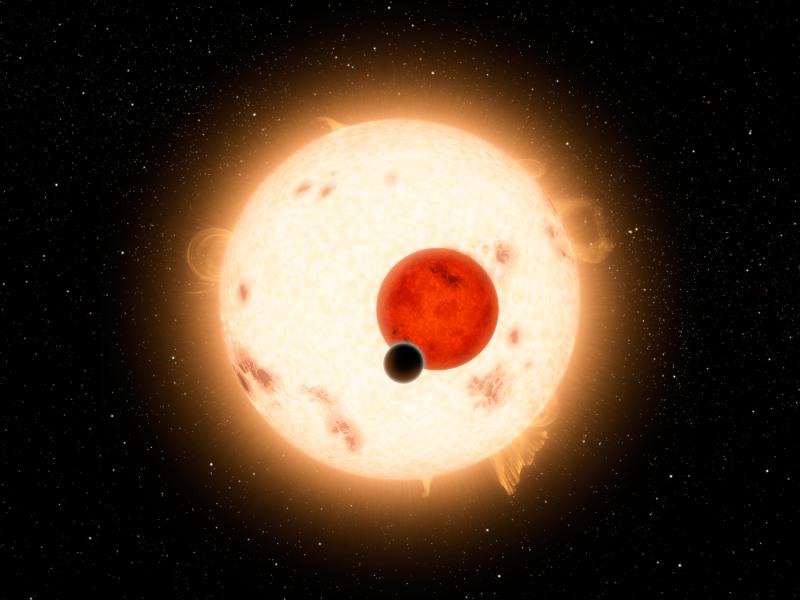
NASA's Kepler mission has discovered a world where two suns set over the horizon instead of just one. The planet, called Kepler-16b, is the most "Tatooine-like" planet yet found in our galaxy and is depicted here in this artist's concept with its two stars. Tatooine is the name of Luke Skywalker's home world in the science fiction movie Star Wars. In this case, the planet it not thought to be habitable. It is a cold world, with a gaseous surface, but like Tatooine, it circles two stars. The largest of the two stars, a K dwarf, is about 69 percent the mass of our sun, and the smallest, a red dwarf, is about 20 percent the sun's mass.


Most of what we know about the size of stars comes from pairs of stars that are oriented toward Earth in such a way that they are seen to eclipse each other. These star pairs are called eclipsing binaries. In addition, virtually all that we know about the size of planets around other stars comes from their transits across their stars. The Kepler-16 system combines the best of both worlds with planetary transits across an eclipsing binary system. This makes Kepler-16b one of the best-measured planets outside our solar system.

Kepler-16 orbits a slowly rotating K-dwarf that is, nevertheless, very active with numerous star spots. Its other parent star is a small red dwarf. The planetary orbital plane is aligned within half a degree of the stellar binary orbital plane. All these features combine to make Kepler-16 of major interest to studies of planet formation as well as astrophysics.
3:47 AM | 0 comments | Read More

Ice Conditions Key To Antarctic Ice Breakup

Written By admin on Friday, September 16, 2011 | 7:44 PM

We recently read in the news that the earthquake and tsunami that struck Japan in March was strong enough to send waves that snapped a Manhattan-sized chunk of ice off the Sulzberger Ice Shelf some 8,100 miles away.

That’s true, but as pointed out at the end of this piece, there’s more to this story than just the strength of the earthquake. Though it’s not making it into the headlines, the condition of the ice in the region was also key. Specifically, the lack of nearby sea ice, coastal ice (also called fast or landfast ice) and pack ice made the portion of the Sulzberger Ice Shelf that broke off particularly susceptible to the incoming waves from the tsunami.
Antarctic iceberg breakup.

“The recent calving from the Sulzberger Ice Shelf suggests that, while the rifts provide the ice-shelf front with a zone that is weakened with respect to stress, and while tsunamis arrive episodically to cause vibrational disturbances to these rifts, some additional enabling condition must be satisfied before a given tsunami can lead to the detachment of an iceberg.

The timing of the earthquake and tsunami in Japan coincided with the typical summer sea-ice minimum . As observed in the MODIS imagery and confirmed in the ASAR imagery, the region north of the Sulzberger Ice Shelf was devoid of either fast or pack ice at the time of predicted arrival of the tsunami. Fast ice is an important factor in ice shelf stability . Additionally, the absence of sea ice meant that the energy associated with the tsunami incident on the ice-shelf front was not damped by sea-ice flexure.

With a distant tsunami source, over an irregular ocean bathymetry, and taking into account the dispersion of high-frequency components of the tsunami outside the shallow-water approximation, a complex pattern of dispersed waves is predicted in the wake of the leading front of the tsunami , As these waves interacted with the ice shelf over a period of hours to days, flexural modes may have been resonantly excited, each with the potential to trigger iceberg calving , in a pattern reminiscent of the delayed response of harbors documented in the far field during the 2004 Sumatra tsunami
7:44 PM | 0 comments | Read More

One million years old Giant Crystals Cave (It's Superman Home....?)

Written By admin on Thursday, September 15, 2011 | 3:43 AM

The largest natural crystals on Earth have been discovered in two caves within a silver and zinc mine near Naica, in Chihuahua, Mexico, according to mine officials. Reaching lengths of over 20 feet, the clear, faceted crystals are composed of selenite, a crystalline form of the mineral gypsum.


The gigantic plaster crystals that occupy the interior of the Mexican cave of Naica take growing until a million years, although recently they have only been shortages. Although they get to measure 11 meters in length and a meter of width, these selenitas (its scientific name) grow at a speed slow, incredibly equivalent to the thickness of a hair every 100 years and therefore much more reduced that the one of stalactites and stalagmites, have concluded the scientists have studied who them. Led by the the crystallographer Juan Manuel García Ruiz, of the CSIC, a Spanish-Japanese equipment it designed a highly sensitive microscope with which it studied samples of crystals of the cave, one of the several that contain these formation in the mine of Naica. The investigation is published in cover in the Proceedings magazine of the National Academy of Sciences (the USA).

“The growth of these formation is so slow that until now it was almost impossible to measure. We have obtained it thanks to a special microscope that we have designed in collaboration with a group of investigation of the University of Sendai, of Japan. This instrument has allowed us to consider that some of crystals of the cave have been growing during near a million years”, explains Garci'a Ruiz, of the Institute Andalusian of Sciences of the Earth. Indeed this Spanish scientist found a in Sendai completing the job when it happened the great earthquake of this year and these days he is in Mexico to continue it.

The crystals constitute a unique geologic patrimony that is precise to study for its conservation, and the study has demonstrated that the humidity and the temperature are the variables most important to control. The investigators analyzed the reactivity of plaster to different temperatures from underground waters of the mines of Naica, that flooded the Cave of Crystals throughout the growth process and allowed the formation of enormous selenitas. Tested indicated that the crystals began to grow when the temperature under 58 degrees Celsius in a very slow process next to the balance and stopped doing it to the 50 present degrees. To 55 degrees the microscope until now revealed the minimum speed of growth observed in any crystal. “The mines of Naica are rich in silver, lead and zinc, and at present they are continued exploding. For that reason no longer there is water in the cave and the crystals have stopped to grow, but someday, when they stop pumping the water towards the outside, the water returns to the room, the selenita crystals, that already are the majors of the world, will continue growing”, adds the investigator.

Read more about the Giant crystals cave at the following link below :
3:43 AM | 0 comments | Read More

Earth Picture of the Day

Written By admin on Wednesday, September 14, 2011 | 10:36 AM

Nature Wallpaper


10:36 AM | 0 comments | Read More

The Brightness of the Sun


The bright sun, a portion of the International Space Station and Earth's horizon are featured in this image photographed during the STS-134 mission's fourth spacewalk in May 2011. The image was taken using a fish-eye lens attached to an electronic still camera.
9:46 AM | 0 comments | Read More

New Planet Discovered

Written By admin on Tuesday, September 13, 2011 | 1:00 PM


Image above: These time-lapse images of a newfound planet in our solar system, called 2003UB313, were taken on Oct. 21, 2003, using the Samuel Oschin Telescope at the Palomar Observatory near San Diego, Calif. The planet, circled in white, is seen moving across a field of stars. The three images were taken about 90 minutes apart.


Scientists did not discover that the object in these pictures was a planet until Jan. 8, 2005. Image credit: Samuel Oschin Telescope, Palomar Observatory


Image above: This artist's concept shows the planet catalogued as 2003UB313 at the lonely outer fringes of our solar system. Our Sun can be seen in the distance. The new planet, which is yet to be formally named, is at least as big as Pluto and about three times farther away from the Sun than Pluto. It is very cold and dark.
1:00 PM | 0 comments | Read More

NEWLY-DISCOVERED STAR


NEWLY-DISCOVERED STAR MAY BE THIRD-CLOSEST

Artist's concept of close new star
Image 1
Click on image for a 6 meg QuickTime movie
Click here for a larger image
The local celestial neighborhood just got more crowded with a discovery of a star that may be the third closest to the Sun. The star, "SO25300.5+165258," is a faint red dwarf star estimated to be about 7.8 light-years from Earth in the direction of the constellation Aries.


The local stellar neighborhood
Image 2
Click image for a 12 meg QuickTime movie
Click here for a larger image
"Our new stellar neighbor is a pleasant surprise, since we weren't looking for it," said Dr. Bonnard Teegarden, an astrophysicist at NASA's Goddard Space Flight Center, Greenbelt, Md. Teegarden is lead author of a paper announcing the discovery to be published by the Astrophysical Journal. This work has been done in close collaboration with Dr. Steven Pravdo of NASA's Jet Propulsion Laboratory (JPL).


Size comparison between Sun and new star
Image 3
Click here for a larger image
If its distance estimate is confirmed, the newfound star will be the Sun's third-closest stellar neighbor, slightly farther than the Alpha Centauri system, actually a group of three stars a bit more than four light-years away, and Barnard's star, about six light-years away. One light-year is almost six trillion miles, or nearly 9.5 trillion kilometers.


The new star has only about seven percent of the mass of the Sun, and it is 300,000 times fainter. The star's feeble glow is the reason why it has not been seen until now, despite being relatively close.
"We discovered this star in September 2002 while searching for white dwarf stars in an unrelated program," said Teegarden. The team was looking for white dwarf stars that move rapidly across the sky. Celestial objects with apparent rapid motion are called High Proper Motion (HPM) objects. A HPM object can be discovered in successive images of an area of sky because it noticeably shifts its position while its surroundings remain fixed. Since either a distant star moving quickly or a nearby star moving slower can exhibit the same HPM, astronomers must use other measurements to determine its distance from Earth.

During its star search, the team used the SkyMorph database for the Near Earth Asteroid Tracking (NEAT) program. NEAT is a NASA program, run by the Jet Propulsion Laboratory (JPL), Pasadena, Calif., to search for asteroids that might be on a collision course for Earth. SkyMorph was separately supported by NASA's Applied Information Systems Research Program. Like HPM stars, asteroids reveal themselves when they shift their position against background stars in successive images. Automated telescopes scan the sky, accumulating thousands of images for the NEAT program, which have been incorporated into SkyMorph, a web-accessible database, for use in other types of astronomical research.

Once the star revealed itself in the NEAT images, the team found other images of the same patch of sky to establish a rough distance estimate by a technique called trigonometric parallax. This technique is used to calculate distances to relatively close stars. As the Earth progresses in its orbit around the Sun, the position of a nearby star will appear to shift compared to background stars much farther away -- the larger the shift, the closer the star.

The team refined their initial distance estimate with another technique called photometric parallax. They used the 3.5-meter Astrophysical Research Consortium telescope at the Apache Point observatory, Sunspot, N.M., to observe the star and separate its light into its component colors for analysis. This allowed the team to determine what kind of star it is. The analysis indicates it's similar to a red dwarf star (spectral type M6.5) that's shining by fusing hydrogen atoms in its core, like our Sun (called a main sequence star).

Once the type of star is known, its true brightness, called intrinsic luminosity, can be determined. Since all light-emitting objects appear dimmer as distance from them increases, the team compared how bright the new star appeared in their images to its intrinsic luminosity to improve their distance estimate.

Although the star resembles a M6.5 red dwarf, it actually appears three times dimmer than expected for this kind of star at the initial distance estimate of 7.8 light-years. The star could therefore really be farther than the rough trigonometric distance indicates; or, if the initial estimate holds, it could have unusual properties that make it shine less brightly than typical M6.5 red dwarfs. A more precise measurement of the new star's position to establish an improved trigonometric parallax distance is underway at the U.S. Naval Observatory. This will confirm or refute its status as one of our closest neighbors by late this year. Either way, we might get even more company soon: "Since the NEAT survey only covered a band of the sky (+/- 25 degrees in declination), it is entirely possible that other faint nearby objects remain to be discovered," said Teegarden.
9:46 AM | 0 comments | Read More

What Is Katia

Written By Admin on Monday, September 5, 2011 | 12:44 PM

Katia was a tropical storm gathering energy over the Atlantic Ocean, Katia is new on the rotating list of names for tropical storms and hurricanes; it replaces the name Katrina, which was retired after the 2005 hurricane season.


While parts of the East Coast and New England are still recovering from Hurricane Irene, a new storm is brewing in the Atlantic, Tropical Storm Katia. The TRMM satellite looked "under the hood" of the storm and saw heavy rainfall rates and towering clouds providing a clue that she was going to strengthen and may become a hurricane .

Katia began as an area of low pressure that had moved away from the coast of Africa south of the Cape Verde Islands in the central eastern Atlantic. Storms forming in this region are known as "Cape Verde" storms. They tend to be larger and stronger than average because of the open ocean and occur most often in August and September during the height of the hurricane season. Irene was a Cape Verde storm.

Katia is expected to continue on its current west-northwest track passing north of the Leeward Islands. It is also forecast to become a hurricane and possibly a major hurricane as it encounters warmer waters and reduced wind shear.
12:44 PM | 0 comments | Read More

The Legend Of Crop Circle

Written By Admin on Sunday, January 30, 2011 | 5:07 AM

Crop_Circle
A crop circle is a sizable pattern created by the flattening of a crop such as wheat, barley, rye, maize, or rapeseed. Crop circles are also referred to as crop formations, because they are not always circular in shape. While the exact date crop circles began to appear is unknown, the documented cases have substantially increased from the 1970s to current times. Twenty-six countries ended up reporting approximately ten-thousand crop circles, in the last third of the 20th century, and 90% of those were located in southern England. Many of the formations appearing in that area are positioned near ancient monuments, such as Stonehenge. Formations usually are made overnight, but have also been made during the day. The most widely known method for a person or group to construct a crop formation is to tie one end of a rope to an anchor point, and the other end to a board which is used to crush the plants. More recent methods include the use of a lawn roller.

Some crop formations are paid for by companies who use them as advertising. Other formations are sometimes claimed by individuals or groups without any evidence to support their assertion, usually after undesirable legal repercussions become unlikely.

History of Crop Circle

Certain evidence, such as the Mowing-Devil, suggest the appearance of crop circles well before the 20th century. Nevertheless, there are important differences between that story and modern crop circles. The story of the mowing devil involves the cutting of the crops following a dispute over crop harvesting and an invocation of the devil, no geometric patterns were reported.

Certain evidence, such as the Mowing-Devil, suggest the appearance of crop circles well before the 20th century. Nevertheless, there are important differences between that story and modern crop circles. The story of the mowing devil involves the cutting of the crops following a dispute over
5:07 AM | 0 comments | Read More

Our Planet and Sun

Written By Admin on Thursday, January 27, 2011 | 4:34 AM

What causes the sun to vary? 

our earthWe live in the extended atmosphere of a magnetic variable star that drives our solar system and sustains life on Earth. Our Sun varies in every way we can observe it. The Sun gives off light in the infrared, visible, ultraviolet, and at x-ray energies, and it gives off magnetic field, bulk plasma (the solar wind) and energetic particles moving up to nearly the speed of light, and all of these emissions vary. These variations occur on timescales from milliseconds to billions of years. Most of these variations are related to the solar magnetic field, which is caused by the moving plasma inside the rotating Sun, which make a dynamo. 

How do the Earth and Heliosphere respond?

Our planet is immersed in this seemingly invisible yet exotic and inherently dangerous environment. Above the protective cocoon of Earth’s lower atmosphere is a plasma soup composed of electrified and magnetized matter entwined with penetrating radiation and energetic particles. The Earth’s magnetic field interacts with the Sun’s outer atmosphere to create this extraordinary environment.

Our Sun’s explosive energy output forms an immense, complex magnetic fields structure. Hugely inflated by the solar wind, this colossal bubble of magnetism known as the heliosphere stretches far beyond the orbit of Pluto, from where it controls the entry of cosmic rays into the solar system. On its way through the Milky Way this extended atmosphere of the Sun affects all planetary bodies in the solar system. It is itself influenced by slowly changing interstellar conditions that in turn can affect Earth’s habitability. In fact, the Sun’s extended atmosphere drives some of the greatest changes in the near-Earth space environment affecting our magnetosphere, atmosphere, ionosphere, and potentially our climate.

What are the impacts on humanity?

Modern society depends heavily on a variety of technologies that are susceptible to the extremes of space weather — severe disturbances of the upper atmosphere and of the near-Earth space environment that are driven by the magnetic activity of the Sun. Strong electrical currents driven in the Earth’s surface during auroral events can disrupt and damage modern electric power grids and may contribute to the corrosion of oil and gas pipelines. Changes in the ionosphere during geomagnetic storms driven by magnetic activity of the Sun interfere with high-frequency radio communications and GPS navigation. During polar cap absorption events caused by solar protons, radio communications can be severely compromised for commercial airliners on transpolar crossing routes. Exposure of spacecraft to energetic particles during solar energetic particle events and radiation belt enhancements can cause temporary operational anomalies, damage critical electronics, degrade solar arrays, and blind optical systems such as imagers and star trackers used on commercial and government satellites.

Harsh conditions in the space environment also pose significant risks for the journey of exploration. Although space is a near-vacuum, the very-thinly-spread particles and fields are like an ocean that can affect the spacecraft and astronauts that travel through it. Like seafaring voyagers, space explorers must be constantly aware of the current space weather and be prepared to handle the most extreme conditions that might be encountered.
4:34 AM | 0 comments | Read More