Welcome Guys

Showing posts with label our home. Show all posts

What's the Global Fire Trend?

Written By admin on Thursday, September 15, 2011 | 4:11 PM

Wildfires that have destroyed more than a thousand homes and threaten thousands more continue to rage every years. Meteorologists point out that drought and an influx of wind from Tropical Storm Lee have fanned the flames and fueled the rash of fires, the most severe Texas has experienced in recent memory.
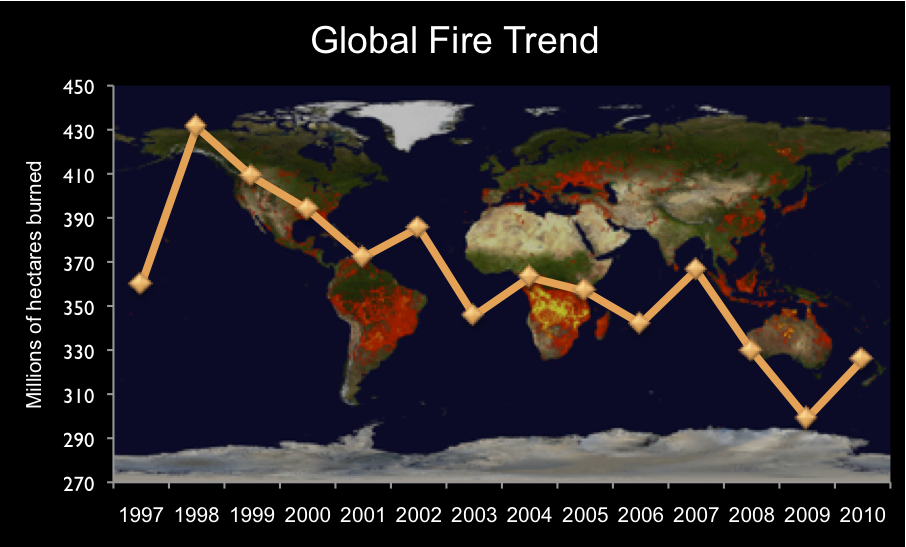
But what do we know about the broader context of the fires? Can we say with any certainty, for example, that fires have become more common in the United States – and across the globe – in the last few decades as global temperatures have increased?

The answer to that question, I found after hunting through various journal articles and checking in with some of Goddard Space Flight Center's fire specialists, is complex. Satellites offer the most comprehensive and reliable measure of the amount of land burned each year; however, satellite-based records of fire activity are still relatively brief.

The longest fire record I’ve seen published so far, a piece of research authored by Goddard's Louis Giglio and the University of California, Irvine’s James Randerson, goes back about thirteen years, not long enough to make particularly definitive statements about the nature of long-term fire trends. (The launch of the NPOESS Preparatory Project (NPP) will help as it will carry an instrument capable of monitoring fires that should add another five-to-ten years to the long-term record.)

Still, Giglio and his colleagues have pieced together hints of trends that are worth noting. Between 1997 and 2008, they show that the number of hectares burned across the globe has declined a significant amount from a maximum in 1998 to a minimum in 2008 (see graph above). The area burned in the United States, which is less than a percent of the total area burned each year, has seen peaks in 2000 and 2007.

What’s driving the global decline in area burned? The topic is ripe for more research, but when I asked Giglio that question he reminded me that, contrary to what one might expect, increasing global temperatures and drought do not invariably produce increases in fire activity.
4:11 PM | 0 comments | Read More

Earth Picture of the Day

Written By admin on Wednesday, September 14, 2011 | 10:36 AM

Nature Wallpaper


10:36 AM | 0 comments | Read More

SERVIR Launches Himalayan Node in Nepal

Written By Admin on Thursday, November 11, 2010 | 2:34 AM

SERVIR-Himalaya made its successful debut in Kathmandu, Nepal, on Oct. 5, taking the stage as the third global node in the SERVIR Regional Visualization and Monitoring System. SERVIR-Himalaya expands the collaboration between NASA, the U.S. Agency for International Development, or USAID, and international partners to meet development challenges by "linking space to village."

The partners inaugurated the state-of-the-art regional monitoring system at a ribbon-cutting ceremony attended by NASA Administrator Charles Bolden and Michael Yates, senior deputy assistant administrator of USAID's Bureau for Economic Growth, Agriculture and Trade. The team at SERVIR-Himalaya's host institution, the International Centre for Integrated Mountain Development, or ICIMOD, was represented by Director General Andreas Schild and Basanta Shrestha, division head of ICIMOD's Mountain Environment and Natural Resources Information System.

Mr. Shrestha highlighted the local perspective on the Himalayan node launch: "Through the partnership with USAID and NASA on SERVIR-Himalaya, ICIMOD will be able to augment its capacity and its network of cooperative partners in the region to use Earth observation for societal benefits of the mountain communities." SERVIR features web-based access to satellite imagery, decision-support tools and interactive visualization capabilities. It puts previously inaccessible information into the hands of scientists, environmental managers and decision-makers.

Indeed, the name SERVIR comes from the Spanish verb "to serve," and SERVIR-Himalaya will serve the Hindu Kush-Himalaya region, including the partner nations of Afghanistan, Bangladesh, Bhutan, China, India, Nepal and Pakistan.

Approximately 1.3 billion people depend on the ecosystem services provided by the Himalayan mountains, yet the region is known as Earth's "third pole" because of its inaccessibility and the vast amount of water stored there in the form of ice and snow. SERVIR will integrate Earth science data from NASA satellites with geospatial information products from other government agencies to support and expand ICIMOD's focus on critical regional issues such as disaster management, biodiversity conservation, trans-boundary air pollution, snow and glacier monitoring, mountain ecosystem management and climate change adaptation.

It's no wonder that Prof. José Achache, director of the Group on Earth Observations, touted SERVIR-Himalaya as furthering the Global Earth Observing System of Systems or GEOSS. SERVIR was developed in coordination with the group, which includes more than 80 nations working together to build GEOSS to serve the needs of people the world over.

SERVIR grew out of collaboration between USAID and researchers at NASA's Marshall Space Flight Center in Huntsville, Ala.

"NASA's science mission begins here on Earth, with greater awareness and understanding of our changing planet, and solutions for protecting our environment, resources and human lives," Administrator Bolden said.

"The SERVIR technology and our partnership with various organizations and people around the globe reflect NASA's commitment to improving life on our home planet for all people," he added.

According to Mr. Yates, USAID’s perspective reflects a similar goal. "We are pleased to work with our partners in Nepal, and in other regions of the world, to build capacity to use satellite data and mapping technologies for making practical decisions that improve people’s lives," he said.

Since 2005, SERVIR has served the Mesoamerican region and the Dominican Republic from the Water Center for the Humid Tropics of Latin America and the Caribbean, which is based in Panama. SERVIR also has served East Africa since 2008, operating from the Regional Center for Mapping of Resources for Development in Nairobi, Kenya.

The SERVIR program is operated by the Earth Science Division's Applied Sciences Program in NASA's Science Mission Directorate in Washington. Four other NASA field centers work with the Marshall Center on the program: NASA's Goddard Space Flight Center in Greenbelt, Md., NASA's Ames Research Center in Moffet Field, Calif., NASA's Jet Propulsion Laboratory in Pasadena, Calif., and NASA's Langley Research Center in Hampton, Va.
2:34 AM | 0 comments | Read More

Save Our Earth

Written By Admin on Wednesday, November 3, 2010 | 12:12 AM


The Blue Planet

Earth (or the Earth) is the third planet from the Sun, and the densest and fifth-largest of the eight planets in the Solar System. It is also the largest of the Solar System's four terrestrial planets. It is sometimes referred to as the World, the Blue Planet, or by its Latin name,
Home to millions of species including humans, Earth is currently the only place where life is known to exist. The planet formed 4.54 billion years ago, and life appeared on its surface within a billion years. Earth's biosphere has significantly altered the atmosphere and other abiotic conditions on the planet, enabling the proliferation of aerobic organisms as well as the formation of the ozone layer which, together with Earth's magnetic field, blocks harmful solar radiation, permitting life on land. The physical properties of the Earth, as well as its geological history and orbit, have allowed life to persist during this period. The planet is expected to continue supporting life for at least another 500 million years.
Our planet is the third planet from the Sun and the fifth largest of the eight planets in our Solar System. It is located between Mars and Venus, which are also terrestrial planets. Earth has a number of nicknames including the Blue Planet and Terra. The most remarkable thing about our planet is the life that thrives all over our planet. Not only are there plants, but there are also animals, sea creatures, birds, and other diverse species.
Scientists have often tried to discover what makes earth such an ideal place for sustaining life. The Earth has been described as being in the habitable zone, which is a theoretical area in a Solar System where the conditions are optimal for the existence of life. Scientists are using the habitable zone to find extrasolar planets that may be able to support life. Earth is also the only planet in our Solar System with tectonic plates. The plate tectonics help protect our planet from overheating like Venus because the carbon in plants makes its way back into the Earth and is recycled. Liquid water is also an important element for life. Just over 70% of Earth’s surface area is water.
Our planet’s atmosphere helps keep heat trapped around the planet as well as protects us from the vacuum of space. The atmosphere is comprised of a variety of chemicals. It is mostly nitrogen (77%) and oxygen (21%). It also contains small amounts of water, carbon dioxide, argon, and other substances.
Earth is the densest planet in the Solar System, with an average density of approximately 5520 kg/m 3, which is more than five times the density of water. The planet is so dense because it is composed of large amounts of iron. Most of the iron is concentrated in the core which is 88% iron. Because the planet is so dense, its gravity is great compared to its size. The temperature on our planet is not as extreme as the temperature of the other planets. The lowest recorded temperature on Earth is approximately -89°C in Antarctica while the highest recorded temperature is 58°C.  The diameter of the planet is 12,742 kilometers, and the volume is 1,080,000,000,000 km3. The planet is not a perfect sphere. It is actually an oblate spheroid. That means it is squished at the poles, so it bulges out at the equator. This is caused by the speed of the Earth’s rotation and is common with all the planets.

12:12 AM | 0 comments | Read More

Hurricane

Written By Admin on Saturday, October 16, 2010 | 9:00 AM

In 2010, there were 14 named storms, of which 7 were hurricanes and 5 were major hurricanes (that is, category-3, 4 and 5 ones). Hurricane activity this year was about 1.5 times the median hurricane activity level.A hurricane is an intense tropical storm. Tropical storms form over warm tropical oceans when local sea surface temperatures are above 26.5°C (80°F) through a depth of at least 50 meters (160 ft). Under these conditions, evaporation from the ocean surface creates very high humidity in the atmosphere, which in turn generates thunderstorms.

A surefire way to kill a hurricane? Add something called “vertical wind shear” — essentially a change in wind speed and direction with height. It stops the storm from forming in its tracks by ripping it apart.  Another way to kill a hurricane? Whip up a wind across the deserts of northern Africa. Dust gets swept up into the air and helps damp down developing storms. (In fact, it’s the effect of the dust combined with vertical wind shear and super-dry air that’s the killer.)

There’s a school of thought that says that climate change should fuel more hurricanes and more intense ones, because as the planet warms, ocean waters warm and sea surface temperature rises.
In a paper published earlier this year in Science, Thomas R. Knutson, of the Geophysical Fluid Dynamics Laboratory at the National Oceanic and Atmospheric Administration (NOAA) and co-authors suggest that we should expect an increase in the frequency of the strongest hurricanes in the Atlantic, roughly by a factor of two by the end of the century, despite a decrease in the overall number of hurricanes. “But we should not expect this trend to be clearly detectable until we near the end of the century, given a scenario in which CO2 [carbon dioxide] doubles by 2100.” The relationship will become more apparent as we improve our understanding and data and as the climate continues to warm.

9:00 AM | 0 comments | Read More

Study the Sun During Solar Week

Want to build a pinhole camera to look at an eclipse? Or learn more about how gigantic telescopes examine the sun? The place to go on the Web is solarweek.org from October 18-22. Twice a year, Solar Week provides a weeklong series of web-based educational activities for classrooms about our magnetic variable star, the sun, and its interactions with Earth and the solar system.

Each day of Solar Week offers a different set of lessons and games for students ranging from the upper elementary to high school level. The site covers everything from solar radiation to pursuing careers in science. For example, on Monday, after learning details about how the sun is a star just like the other ones in the sky, students can play a game to determine just where the sun lies in the Milky Way. Or on Thursday, they measure how fast a coronal mass ejection races from the sun.

Helping to answer the students’ questions on an online bulletin board will be three scientists from NASA’s Goddard Space Flight Center in Greenbelt, Md. who have been involved almost since the project began in 2000. Throughout the week, Heliophysics researchers Terry Kucera, Dawn Myers, and Holly Gilbert will be among some twenty scientists who will share their excitement about the dynamic star at the center of our solar system. “I think it’s great that the kids get direct interaction with the scientists,” says solar physicist Kucera, who is involved with the Solar and Heliospheric Observatory and the Solar Terrestrial Relations Observatory.

Currently run by UC Berkeley, Solar Week was originated by David Alexander in 2000 in coordination with his public outreach work for the Yohkoh solar observatory. He began Solar Week as a means of reaching out to girls and encouraging them in the sciences – incorporating many female solar scientists as role models. The site incorporates only women scientists, but welcomes students of both sexes. The former Sun-Earth Connection Education Forum at UC Berkeley took over Solar Week in 2003 where it is now managed by Karin Hauck and funded through spring of 2011 by NASA’s Sun-Earth Day. Berkeley has continued the tradition of incorporating student interaction with leading scientists at the forefront of Sun-Earth research. “The part of the website I enjoy most is the interactive message board because it’s dynamic,” says Hauck. “You never know what’s going to pop up. Students can be very creative with their questions, and I always learning something new from the scientists’ answers.”

Since one of the goals of Solar Week is to encourage girls to pursue STEM (science, technology, engineering, and math) careers, the Goddard scientists often have to answer questions about their jobs specifically, such as how often they travel or whether their jobs are impacted by the current economy –- and, of course, hobbies like Gilbert’s tournament pool-playing and Myers’s work as a dance teacher come up as well.

“I’m always so grateful,” says Hauck, “that these incredibly busy scientists are willing, year after year, to take time out of their very busy schedules to answer the students’ questions.”

Solar Week is ideal for students studying the solar system, the stars, or astronomy in general. It's also for kids wondering what it's like being a scientist, and pondering possible career choices. For those who miss this week, the activities remain online all year around, but the scientists won’t be available again to answer questions online until next March.

Related Links: http://www.nasa.gov/topics/solarsystem/sunearthsystem/main/SolarWeek2010.html
8:55 AM | 0 comments | Read More

About Earth


Earth (or the Earth) is the third planet from the Sun, and the densest and fifth-largest of the eight planets in the Solar System. It is also the largest of the Solar System's four terrestrial planets. It is sometimes referred to as the World, the Blue Planet, or by its Latin name, Terra.
Home to millions of species including humans, Earth is currently the only place where life is known to exist. The planet formed 4.54 billion years ago, and life appeared on its surface within a billion years. Earth's biosphere has significantly altered the atmosphere and other abiotic conditions on the planet, enabling the proliferation of aerobic organisms as well as the formation of the ozone layer which, together with Earth's magnetic field, blocks harmful solar radiation, permitting life on land.The physical properties of the Earth, as well as its geological history and orbit, have allowed life to persist during this period. The planet is expected to continue supporting life for at least another 500 million years.
  
Earth is the third planet from the Sun

The Earth's average distance from the Sun is 149,597,890 km (92,955,820 miles) or one astronomical unit (AU). Located between Venus and Mars, some people have called it the "third rock from the sun."  Our planet's rapid spin and molten nickel-iron core give rise to a magnetic field, which the solar wind distorts into a teardrop shape. The magnetic field does not fade off into space, but has definite boundaries. Just like the field around a magnet, ours is also polarized. When charged particles from the solar wind become trapped in Earth's magnetic field, they collide with air molecules above our planet's magnetic poles. These air molecules then begin to glow and are known as the aurorae, or the Northern and Southern Lights. 

earth's atmosphere is 77% nitrogen, 21% oxygen, with traces of argon, carbon dioxide and water. This atmosphere affects Earth's long-term climate and short-term local weather; shields us from nearly all harmful radiation coming from the Sun; and protects us from meteors as well - most of which burn up before they can strike the surface. All of the things we need to survive are provided under a thin layer of atmosphere that separates us from the uninhabitable void of space. Earth is made up of complex, interactive systems that are often unpredictable. Air, water, land, and life - including humans - combine forces to create a constantly changing world that we are striving to understand.

Our close proximity prevents us from seeing Earth in its entirety To completely view our own planet, we must leave its surface and journey into space. From the vantage point of space we are able to observe our planet globally, as we do other planets, using similar sensitive instruments to understand the delicate balance among its oceans, air, land, and life. Viewing Earth from the unique perspective of space provides the opportunity to see Earth as a whole. Scientists around the world have discovered many things about our planet by working together and sharing their findings.

Earth interacts with other objects in space, especially the Sun and the Moon. At present, Earth orbits the Sun once for every roughly 366.26 times it rotates about its axis, which is equal to 365.26 solar days, or one sidereal year.The Earth's axis of rotation is tilted 23.4° away from the perpendicular to its orbital plane, producing seasonal variations on the planet's surface with a period of one tropical year (365.24 solar days). Earth's only known natural satellite, the Moon, which began orbiting it about 4.53 billion years ago, provides ocean tides, stabilizes the axial tilt and gradually slows the planet's rotation. Between approximately 3.8 billion and 4.1 billion years ago, numerous asteroid impacts during the Late Heavy Bombardment caused significant changes to the greater surface environment.
EarthFacts.net holds a collection of facts about the planet Earth and some of the lifeforms living on it, as well as some creatures that no longer exist on Earth. We know more today than ever before about our planet Earth and what’s going on around us. Science is always continuing to connect the dots through Earth research, study, and experimentation. As technology advances, we continue to learn and find more out about our planet Earth.
Earth, our home planet, is a beautiful blue and white ball when seen from space. The third planet from the Sun, it is the largest of the inner planets. Earth is the only planet known to support life and to have liquid water at the surface. Earth has a substantial atmosphere and magnetic field, both of which are critical for sustaining life on Earth. Earth is the innermost planet in the solar system with a natural satellite – our Moon


8:17 AM | 0 comments | Read More