Welcome Guys

Showing posts with label galaxy. Show all posts

The Sun Sets Twice

Written By admin on Monday, September 19, 2011 | 3:47 AM

Where the Sun Sets Twice

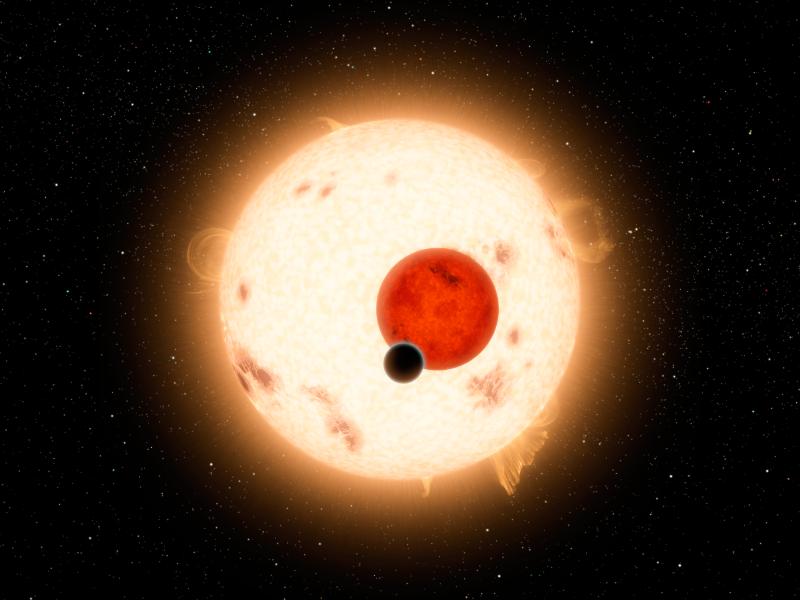
NASA's Kepler mission has discovered a world where two suns set over the horizon instead of just one. The planet, called Kepler-16b, is the most "Tatooine-like" planet yet found in our galaxy and is depicted here in this artist's concept with its two stars. Tatooine is the name of Luke Skywalker's home world in the science fiction movie Star Wars. In this case, the planet it not thought to be habitable. It is a cold world, with a gaseous surface, but like Tatooine, it circles two stars. The largest of the two stars, a K dwarf, is about 69 percent the mass of our sun, and the smallest, a red dwarf, is about 20 percent the sun's mass.


Most of what we know about the size of stars comes from pairs of stars that are oriented toward Earth in such a way that they are seen to eclipse each other. These star pairs are called eclipsing binaries. In addition, virtually all that we know about the size of planets around other stars comes from their transits across their stars. The Kepler-16 system combines the best of both worlds with planetary transits across an eclipsing binary system. This makes Kepler-16b one of the best-measured planets outside our solar system.

Kepler-16 orbits a slowly rotating K-dwarf that is, nevertheless, very active with numerous star spots. Its other parent star is a small red dwarf. The planetary orbital plane is aligned within half a degree of the stellar binary orbital plane. All these features combine to make Kepler-16 of major interest to studies of planet formation as well as astrophysics.
3:47 AM | 0 comments | Read More

Whether The Galaxy Grow ...?

Written By admin on Thursday, September 15, 2011 | 12:05 PM

Galaxy clusters are the largest collapsed objects in the Universe and are ideal for studying the properties of dark energy, the mysterious form of repulsive gravity that is driving the accelerated expansion of the Universe. The growth of these structures was initially driven only by the attractive force of gravity, but then later there was competition with the repulsive force of dark energy.

galaxy_growth
Understanding the nature of dark energy is one of the biggest problems in science. Possibilities include the cosmological constant, equivalent to the energy of empty space, a modification in general relativity on the largest scales, or a more general physical field. The results are remarkably consistent with those from previous results that measure the expansion of the Universe using distance measurements, revealing that general relativity works as expected on large scales. 

And Today 

Herschel Mission Finds Galactic Growth Slow and Steady


The Herschel Infrared Space Observatory discovered that galaxies do not always need to collide with each other to drive vigorous star birth. The finding overturns a long-held assumption and paints a more stately picture of how galaxies evolve. The new results are based on Herschel's observations of two patches of sky, each about one-third the size of the full moon.

These observations are unique because Herschel can obtain data at a wide range of infrared light and reveal a more complete picture of star birth than ever seen before.

Herschel is a European Space Agency cornerstone mission, with science instruments provided by consortia of European institutes and with important participation by NASA JPL, which contributed mission-enabling technology for two of Herschel's three science instruments.
12:05 PM | 0 comments | Read More

Andromeda Galaxy is So Hot 'n' Cold

Written By admin on Sunday, September 11, 2011 | 3:40 PM

Andromeda’s Once and Future Stars

Two European Space Agency observatories combined forces to show the Andromeda Galaxy in a new light. Herschel sees rings of star formation in this, the most detailed image of the Andromeda Galaxy ever taken at infrared wavelengths, and XMM-Newton shows dying stars shining X-rays into space.


ESA’s Herschel and XMM-Newton space observatories targeted the Andromeda Galaxy, the nearest large spiral galaxy, which like our own Milky Way contains several hundred billion stars. This is the most detailed far-infrared image of the Andromeda Galaxy ever taken and clearly shows that more stars are on their way.

In this image, Herschel’s infrared image of the Andromeda Galaxy shows rings of dust that trace gaseous reservoirs where new stars are forming and XMM-Newton’s X-ray image shows stars approaching the ends of their lives. Both infrared and X-ray images convey information impossible to collect from the ground because these wavelengths are absorbed by Earth’s atmosphere.

3:40 PM | 0 comments | Read More

The Triangulum Galaxy

Written By Admin on Tuesday, January 25, 2011 | 2:50 PM

The Triangulum Galaxy is located nearly 3 million light years from Earth. And, in a study that pushes the limits of observations currently possible from Earth, a team of NASA and European scientists recorded the "fingerprints" of mystery molecules in The Triangulum Galaxy, as well as the Andromeda Galaxy.

Figuring out exactly which molecules are leaving these clues, known as "diffuse interstellar bands" (DIBs), is a puzzle that initially seemed straightforward but has gone unsolved for nearly a hundred years. The answer is expected to help explain how stars, planets and life form.

Galaxy
Triangulum Galaxy
The spiral galaxy M33 also is called The Triangulum Galaxy for the constellation in which it resides. About four times smaller (in radius) than our Milky Way Galaxy and the Andromeda Galaxy (M31), it is much larger than the many of the local dwarf spheroidal galaxies. The galaxy's proximity to M31 causes it to be thought by some to be a satellite galaxy of this more massive galaxy.
M33, the Triangulum Galaxy, is a perennial favorite of amateur and professional astronomers alike, due to its orientation and relative proximity to us. It is the second nearest spiral galaxy to our Milky Way (after M31, the Andromeda Galaxy) and a prominent member of the "local group" of galaxies. From our Milky Way perspective, M33's stellar disk appears at moderate inclination, allowing us to see its internal structure clearly, whereas M31 is oriented nearly edge-on.

The Galaxy Evolution Explorer imaged M33 as it appears in ultraviolet wavelengths. Ultraviolet imaging primarily traces emission from the atmospheres of hot stars, most of which formed in the past few hundred million years. These data provide a reference point as to the internal composition of a typical star-forming galaxy and will help scientists understand the origin of ultraviolet emission in more distant galaxies.

These observations of M33 allow astronomers to compare the population of young, massive stars with other components of the galaxy, such as interstellar dust and gas, on the scale of individual giant molecular clouds. The clouds contain the raw material from which stars form. This presents direct insight into the star formation process as it occurs throughout an entire spiral galaxy and constitutes a unique resource for broader studies of galaxy evolution.

2:50 PM | 0 comments | Read More

A Perfect Storm of Turbulent Gases

Written By Admin on Tuesday, January 18, 2011 | 12:51 PM

storm, galaxy

A Perfect Storm of Turbulent Gases

Resembling the fury of a raging sea, this image actually shows a bubbly ocean of glowing hydrogen gas and small amounts of other elements such as oxygen and sulfur.

The photograph, taken by NASA's Hubble Space Telescope, captures a small region within M17, a hotbed of star formation. M17, also known as the Omega or Swan Nebula, is located about 5,500 light-years away in the constellation Sagittarius. The image was released to commemorate the thirteenth anniversary of Hubble's launch.

The wave-like patterns of gas have been sculpted and illuminated by a torrent of ultraviolet radiation from young, massive stars, which lie outside the picture to the upper left. The glow of these patterns accentuates the three-dimensional structure of the gases. The ultraviolet radiation is carving and heating the surfaces of cold hydrogen gas clouds. The warmed surfaces glow orange and red. The intense heat and pressure cause some material to stream away from those surfaces, creating the glowing veil of even hotter greenish gas that masks background structures. The pressure on the tips of the waves may trigger new star formation within them.
12:51 PM | 0 comments | Read More

Small Group Of Galaxies

Written By Admin on Sunday, January 16, 2011 | 4:08 AM

Sometimes galaxies form groups. For example, our own Milky Way Galaxy is part of the Local Group of Galaxies. Small, compact groups, like Hickson Compact Group 87 (HCG 87) shown above, are interesting partly because they slowly self-destruct. Indeed, the galaxies of HCG 87 are gravitationally stretching each other during their 100-million year orbits around a common center. The pulling creates colliding gas that causes bright bursts of star formation and feeds matter into their active galaxy centers. HCG 87 is composed of a large edge-on spiral galaxy visible on the lower left, an elliptical galaxy visible on the lower right, and a spiral galaxy visible near the top. The small spiral near the center might be far in the distance. Several stars from our Galaxy are also visible in the foreground. The above picture was taken in 1999 July by the Hubble Space Telescope's Wide Field Planetary Camera 2. Studying groups like HCG 87 allows insight into how all galaxies form and evolve.

Galaxy groups and clusters are the largest known gravitationally bound objects to have arisen thus far in the process of cosmic structure formation. They form the densest part of the large scale structure of the universe. In models for the gravitational formation of structure with cold dark matter, the smallest structures collapse first and eventually build the largest structures, clusters of galaxies. Clusters are then formed relatively recently between 10 billion years ago and now. Groups and clusters may contain from ten to thousands of galaxies. The clusters themselves are often associated with larger, non-gravitationally bound, groups called superclusters.

Groups of galaxies are the smallest aggregates of galaxies. They typically contain no fewer than 50 galaxies in a diameter of 1 to 2 megaparsecs (Mpc). Their mass is approximately 1013 solar masses. The spread of velocities for the individual galaxies is about 150 km/s. However, this definition should be used as a guide only, as larger and more massive galaxy systems are sometimes classified as galaxy groups.

Our own galaxy, the Milky Way, is contained in the Local Group of galaxies, which contains more than 40 galaxies
4:08 AM | 0 comments | Read More

Galaxy Silhouettes

Written By Admin on Thursday, January 13, 2011 | 2:01 AM

NASA's Hubble Space Telescope has captured a rare alignment between two spiral galaxies. The outer rim of a small, foreground galaxy is silhouetted in front of a larger background galaxy. Skeletal tentacles of dust can be seen extending beyond the small galaxy's disk of starlight.
galaksi, galaxy


Such outer dark dusty structures, which appear to be devoid of stars, like barren branches, are rarely so visible in a galaxy because there is usually nothing behind them to illuminate them. Astronomers have never seen dust this far beyond the visible edge of a galaxy. They do not know if these dusty structures are common features in galaxies.

Understanding a galaxy's color and how dust affects and dims that color are crucial to measuring a galaxy's true brightness. By knowing the true brightness, astronomers can calculate the galaxy's distance from Earth.

Astronomers calculated that the background galaxy is 780 million light-years away. They have not as yet calculated the distance between the two galaxies, although they think the two are relatively close, but not close enough to interact. The background galaxy is about the size of the Milky Way Galaxy and is about 10 times larger than the foreground galaxy.

Most of the stars speckled across this image belong to the nearby spiral galaxy NGC 253, which is out of view to the right. Astronomers used Hubble's Advanced Camera for Surveys to snap images of NGC 253 when they spied the two galaxies in the background. From ground-based telescopes, the two galaxies look like a single blob.
2:01 AM | 0 comments | Read More

The Andromeda Galaxy

Written By Admin on Wednesday, January 12, 2011 | 12:45 AM

Andromeda is the nearest major galaxy to our own Milky Way Galaxy. Our Galaxy is thought to look much like Andromeda. Together these two galaxies dominate the Local Group of galaxies. The diffuse light from Andromeda is caused by the hundreds of billions of stars that compose it. The several distinct stars that surround Andromeda's image are actually stars in our Galaxy that are well in front of the background object. Andromeda is frequently referred to as M31 since it is the 31st object on Messier's list of diffuse sky objects. M31 is so distant it takes about two million years for light to reach us from there. Much about M31 remains unknown, including why the center contains two nuclei.

Andromeda galaxy

The immense Andromeda galaxy, also known as Messier 31 or simply M31, is captured in full in this new image from NASA's Wide-field Infrared Survey Explorer, or WISE. The mosaic covers an area equivalent to more than 100 full moons, or five degrees across the sky. WISE used all four of its infrared detectors to capture this picture (3.4- and 4.6-micron light is colored blue; 12-micron light is green; and 22-micron light is red). Blue highlights mature stars, while yellow and red show dust heated by newborn, massive stars.

Andromeda is the closest large galaxy to our Milky Way galaxy, and is located 2.5 million light-years from our sun. It is close enough for telescopes to spy the details of its ringed arms of new stars and hazy blue backbone of older stars. Also seen in the mosaic are two satellite galaxies, known as M32, located just a bit above Andromeda to the left of center, and the fuzzy blue M110, located below the center of the great spiral arms. These satellites are the largest of several that are gravitationally bound to Andromeda.

The Andromeda galaxy


The Andromeda galaxy is larger than our Milky Way and contains more stars, but the Milky Way is thought to perhaps have more mass due to its larger proportion of a mysterious substance called dark matter. Both galaxies belong to our so-called Local Group, a collection of more than 50 galaxies, most of which are tiny dwarf systems. In its quest to map the whole sky, WISE will capture the entire Local Group.

12:45 AM | 0 comments | Read More

How People Get Back to the Moon

Written By Admin on Monday, January 10, 2011 | 10:01 PM

Before the end of the next decade, NASA astronauts will again explore the surface of the moon. And this time, we're going to stay, building outposts and paving the way for eventual journeys to Mars and beyond. There are echoes of the iconic images of the past, but it won't be your grandfather's moon shot. This journey begins soon, with development of a new spaceship. Building on the best of Apollo and shuttle technology, NASA's creating a 21st century exploration system that will be affordable, reliable, versatile, and safe.
The new ship can be reused up to 10 times. After the craft parachutes to dry land (with a splashdown as a backup option), NASA can easily recover it, replace the heat shield and launch it again.

Coupled with the new lunar lander, the system sends twice as many astronauts to the surface as Apollo, and they can stay longer, with the initial missions lasting four to seven days. And while Apollo was limited to landings along the moon's equator, the new ship carries enough propellant to land anywhere on the moon's surface.

Once a lunar outpost is established, crews could remain on the lunar surface for up to six months. The spacecraft can also operate without a crew in lunar orbit, eliminating the need for one astronaut to stay behind while others explore the surface.

Safe and reliable

The launch system that will get the crew off the ground builds on powerful, reliable shuttle propulsion elements. Astronauts will launch on a rocket called Ares I, which uses a single five-segment solid rocket booster, a derivative of the space shuttle's solid rocket booster, for the first stage. A liquid oxygen/liquid hydrogen J-2X engine derived from the J-2 engine used on Apollo's second stage will power the crew exploration vehicle's second stage. The Ares I can lift more than 55,000 pounds to low Earth orbit.

New heavy lift and crew launch vehicles Ares V, a heavy lift launch vehicle, will use five RS-68 liquid oxygen/liquid hydrogen engines mounted below a larger version of the space shuttle's external tank, and two five-segment solid propellant rocket boosters for the first stage. The upper stage will use the same J-2X engine as the Ares I. The Ares V can lift more than 286,000 pounds to low Earth orbit and stands approximately 360 feet tall. This versatile system will be used to carry cargo and the components into orbit needed to go to the moon and later to Mars. It can be modified to carry crew as well.

Best of all, these launch systems are 10 times safer than the shuttle because of an escape rocket on top of the capsule that can quickly blast the crew away if launch problems develop. There's also little chance of damage from launch vehicle debris, since the capsule sits on top of the rocket.

The Flight Plan

In just five years, the new ship will begin to ferry crew and supplies to the International Space Station. Plans call for as many as six trips to the outpost a year. In the meantime, robotic missions will lay the groundwork for lunar exploration. In 2018, humans will return to the moon. Here's how a mission would unfold:

A heavy-lift rocket blasts off, carrying a lunar lander and a "departure stage" needed to leave Earth's orbit (below left). The crew launches separately (below, center), then docks their capsule with the lander and departure stage and heads for the moon (below, right).

engineering graphics and artwork by John Frassanito and Associates depict a lunar flight plan.

Three days later, the crew goes into lunar orbit (below, left). The four astronauts climb into the lander, leaving the capsule to wait for them in orbit. After landing and exploring the surface for seven days, the crew blasts off in a portion of the lander (below, center), docks with the capsule and travels back to Earth. After a de-orbit burn, the service module is jettisoned, exposing the heat shield for the first time in the mission. The parachutes deploy, the heat shield is dropped and the capsule sets down on dry land (below, right).

engineering graphics and artwork by John Frassanito and Associates depict a lunar flight plan.


'Into the Cosmos'

With a minimum of two lunar missions per year, momentum will build quickly toward a permanent outpost. Crews will stay longer and learn to exploit the moon's resources, while landers make one way trips to deliver cargo. Eventually, the new system could rotate crews to and from a lunar outpost every six months.

Planners are already looking at the lunar south pole as a candidate for an outpost because of concentrations of hydrogen thought to be in the form of water ice, and an abundance of sunlight to provide power.

New lunar lander
These plans give NASA a huge head start in getting to Mars. We will already have the heavy-lift system needed to get there, as well as a versatile crew capsule. A lunar outpost just three days away from Earth will give us needed practice of "living off the land" away from our home planet, before making the longer trek to Mars.
10:01 PM | 0 comments | Read More

Galaxy Triplet ARP 274

Written By Admin on Saturday, January 8, 2011 | 4:15 AM

Galaxy Triplet arp

Arp 274, also known as NGC 5679, is a system of three galaxies that appear to be partially overlapping in the image, although they may be at somewhat different distances. The spiral shapes of two of these galaxies appear mostly intact. The third galaxy (to the far left) is more compact, but shows evidence of star formation.

Two of the three galaxies are forming new stars at a high rate. This is evident in the bright blue knots of star formation that are strung along the arms of the galaxy on the right and along the small galaxy on the left.

The largest component is located in the middle of the three. It appears as a spiral galaxy, which may be barred. The entire system resides at about 400 million light-years away from Earth in the constellation Virgo.

Hubble's Wide Field Planetary Camera 2 was used to image Arp 274. Blue, visible and infrared filters were combined with a filter that isolates hydrogen emission. The colors in this image reflect the intrinsic color of the different stellar populations that make up the galaxies. Yellowish older stars can be seen in the central bulge of each galaxy. A bright central cluster of stars pinpoint each nucleus. Younger blue stars trace the spiral arms, along with pinkish nebulae that are illuminated by new star formation. Interstellar dust is silhouetted against the starry population. A pair of foreground stars inside our own Milky Way are at far right.

The International Year of Astronomy is the celebration of the 400th anniversary of Galileo's first observations with a telescope. People around the world came together to participate in the IYA's 100 Hours of Astronomy, April 2 to 5. This global astronomy event was geared toward encouraging as many people as possible to experience the night sky.
4:15 AM | 0 comments | Read More

Andromeda is So Hot

Written By Admin on Wednesday, January 5, 2011 | 2:43 PM

This mosaic of the Andromeda spiral galaxy highlights explosive stars in its interior, and cooler, dusty stars forming in its many rings. The image is a combination of observations from the Herschel Space Observatory taken in infrared light (seen in orange hues), and the XMM-Newton telescope captured in X-rays (seen in blues). NASA plays a role in both of these European Space Agency-led missions.

Herschel provides a detailed look at the cool clouds of star birth that line the galaxy's five concentric rings. Massive young stars are heating blankets of dust that surround them, causing them to glow in the longer-wavelength infrared light, known as far-infrared, that Herschel sees. 
galaxy andromeda,galaxy,galaksi


In contrast, XMM-Newton is capturing what happens at the end of the lives of massive stars. It shows the high-energy X-rays that come from, among other objects, supernova explosions and massive dead stars rotating around companions. These X-ray sources are clustered in the center of the galaxy, where the most massive stars tend to form.

Andromeda is our Milky Way galaxy's nearest large neighbor. It is located about 2.5 million light-years away and holds up to an estimated trillion stars. Our Milky Way is thought to contain about 200 billion to 400 billion stars. 

M31 Andromeda galaxy
Andromeda: our nearest large galactic neighbour

5 January 2011
Two ESA observatories have combined forces to show the Andromeda Galaxy in a new light. Herschel sees rings of star formation in this, the most detailed image of the Andromeda Galaxy ever taken at infrared wavelengths, and XMM-Newton shows dying stars shining X-rays into space.

During Christmas 2010, ESA’s Herschel and XMM-Newton space observatories targeted the nearest large spiral galaxy M31. This is a galaxy similar to our own Milky Way – both contain several hundred billion stars. This is the most detailed far-infrared image of the Andromeda Galaxy ever taken and shows clearly that more stars are on their way.


Andromeda Galaxy seen in infrared
Sensitive to far-infrared light, Herschel sees clouds of cool dust and gas where stars can form. Inside these clouds are many dusty cocoons containing forming stars, each star pulling itself together in a slow gravitational process that can last for hundreds of millions of years. Once a star reaches a high enough density, it will begin to shine at optical wavelengths. It will emerge from its birth cloud and become visible to ordinary telescopes. Many galaxies are spiral in shape but Andromeda is interesting because it shows a large ring of dust about 75 000 light-years across encircling the centre of the galaxy. Some astronomers speculate that this dust ring may have been formed in a recent collision with another galaxy. This new Herschel image reveals yet more intricate details, with at least five concentric rings of star-forming dust visible.


Andromeda Galaxy in X-rays

Superimposed on the infrared image is an X-ray view taken almost simultaneously by ESA’s XMM-Newton observatory. Whereas the infrared shows the beginnings of star formation, X-rays usually show the endpoints of stellar evolution. XMM-Newton highlights hundreds of X-ray sources within Andromeda, many of them clustered around the centre, where the stars are naturally found to be more crowded together. Some of these are shockwaves and debris rolling through space from exploded stars, others are pairs of stars locked in a gravitational fight to the death.
In these deadly embraces, one star has already died and is pulling gas from its still-living companion. As the gas falls through space, it heats up and gives off X-rays. The living star will eventually be greatly depleted, having much of its mass torn from it by the stronger gravity of its denser partner. As the stellar corpse wraps itself in this stolen gas, it could explode.


Andromeda Galaxy in infrared and X-rays
Both the infrared and X-ray images show information that is impossible to collect from the ground because these wavelengths are absorbed by Earth’s atmosphere. The twinkling starlight seen from Earth is indeed a beautiful sight but in reality contains less than half the story. Visible light shows us the adult stars, whereas infrared gives us the youngsters and X-rays show those in their death throes. To chart the lives of stars, we need to see it all and that is where Herschel and XMM-Newton contribute so much.

 
2:43 PM | 0 comments | Read More

A Galaxy for Everyone

Images taken by NASA's Wide-Field Infrared Explorer
To celebrate the one-year anniversary of the launch of NASA's Wide-Field Infrared Explorer, or WISE, the mission team has put together this image showing just a sample of the millions of galaxies that have been imaged by WISE during its survey of the entire sky. Image credit: NASA/JPL-Caltech/UCLA


This collage of galaxies from NASA's Wide-Field Infrared Survey Explorer, or WISE, showcases the many "flavors" that galaxies come in, from star-studded spirals to bulging ellipticals to those paired with other companion galaxies. The WISE team put this collage together to celebrate the anniversary of the mission's launch on Dec. 14, 2009.

After launch and a one-month checkout period, WISE began mapping the sky in infrared light. By July of this year, the entire sky had been surveyed, detecting hundreds of millions of objects, including the galaxies pictured here. In October of this year, after scanning the sky about one-and–a-half times, the spacecraft ran out of its frozen coolant, as planned. With its two shortest-wavelength infrared detectors still operational, the mission continues to survey the sky, focusing primarily on asteroids and comets.

NGC 300 is seen in the image in the upper left panel. This is a textbook spiral galaxy. In fact, it is such a good representation of a spiral galaxy that astronomers have studied it in great detail to learn about the structure of all spirals in general. Infrared images like this one from WISE show astronomers where areas of gas and warm dust are concentrated -- features that cannot be seen in visible light. At about 39,000 light-years across, NGC 300 is only about 40 percent the size of the Milky Way galaxy.

The upper right image shows Messier 104, or M104, also known as the Sombrero galaxy. Although M104 is also classified as a spiral galaxy, it has a very different appearance than NGC 300. In part, this is because the dusty, star-forming spiral disk in M104 is seen nearly edge-on from our point of view. M104 also has a large, ball-shaped bulge component of older stars, seen here in blue.

The large, fuzzy grouping of stars at the center of the lower left panel is the galaxy Messier 60, or M60. This galaxy does not have a spiral disk, just a bulge, making it a massive elliptical galaxy. M60 is about 20 percent larger than our Milky Way galaxy, and lies in the Virgo cluster of galaxies. The brighter, dense spot inside but off-center from the blue core of M60 is a separate spiral galaxy called NGC 4647. In addition, two different asteroids were caught crossing the field of view when WISE imaged this portion of the sky (seen as dotted green lines extending out from M60 at about the 2 o'clock and 8 o'clock positions).

The galaxy in the lower right panel is Messier 51, or NGC 5194, also frequently referred to as the Whirlpool galaxy. The Whirlpool is a "grand design" spiral galaxy. It is interacting with its smaller companion -- NGC 5195, a dwarf galaxy, which can be seen as a bright spot near the tip of the spiral arm extending up and to the right of the Whirlpool galaxy.
9:08 AM | 0 comments | Read More

Sparkle

Written By Admin on Sunday, January 2, 2011 | 1:50 AM

This Hubble Space Telescope image of galaxy NGC 1275 reveals the fine, thread-like filamentary structures in the gas surrounding the galaxy. The red filaments are composed of cool gas being suspended by a magnetic field, and are surrounded by the 100-million-degree Fahrenheit hot gas in the center of the Perseus galaxy cluster.

The filaments are dramatic markers of the feedback process through which energy is transferred from the central massive black hole to the surrounding gas. The filaments originate when cool gas is transported from the center of the galaxy by radio bubbles that rise in the hot interstellar gas.

At a distance of 230 million light-years, NGC 1275 is one of the closest giant elliptical galaxies and lies at the center of the Perseus cluster of galaxies.
1:50 AM | 0 comments | Read More

Reflection Nebula

Written By Admin on Thursday, December 30, 2010 | 2:30 AM

Nebula

Just weeks after NASA astronauts repaired the Hubble Space Telescope in December 1999, the Hubble Heritage Project snapped this picture of NGC 1999, a reflection nebula in the constellation Orion.

Like fog around a street lamp, a reflection nebula shines only because the light from an embedded source illuminates its dust; the nebula does not emit any visible light of its own. The nebula is famous in astronomical history because the first Herbig-Haro object was discovered immediately adjacent to it (it lies just outside the new Hubble image). Herbig-Haro objects are now known to be jets of gas ejected from very young stars.

The nebula is illuminated by a bright, recently formed star, visible just to the left of center. This star is cataloged as V380 Orionis, and its white color is due to its high surface temperature of about 10,000 degrees Celsius, nearly twice that of our own sun. Its mass is estimated to be 3.5 times that of the sun. The star is so young that it is still surrounded by a cloud of material left over from its formation, here seen as the NGC 1999 reflection nebula.

NGC 1999 shows a remarkable jet-black cloud near its center, located just to the right and lower right of the bright star. This dark cloud is an example of a "Bok globule," named after the late University of Arizona astronomer Bart Bok. The globule is a cold cloud of gas, molecules and cosmic dust, which is so dense it blocks all of the light behind it. The globule is seen silhouetted against the reflection nebula illuminated by V380 Orionis. Astronomers believe that new stars may be forming inside Bok globules, through the contraction of the dust and molecular gas under their own gravity.
2:30 AM | 0 comments | Read More

Fornax Galaxy Cluster

Written By Admin on Wednesday, December 29, 2010 | 8:48 AM

This image of a dense cluster of galaxies was captured by NASA's Wide-field Infrared Survey Explorer, or WISE. The cluster, called Fornax because of its location in a constellation of the same name, is 60 million light-years from Earth, and is one of the closest galaxy clusters to the Milky Way. Clusters are large families of galaxies that are gravitationally bound together, containing enough matter to pull even distant galaxies toward them.


WISE's large field of view and multi-wavelength infrared sight allowed it to form this complete view of the cluster, containing dozens of bright galaxies and hundreds of smaller ones. Old stars show up at the shorter infrared wavelengths, color coded blue. Dust heated by new generations of stars lights up at longer infrared wavelengths, colored red here.


The center of the cluster is dominated by the galaxy known as NGC 1399, a large spheroidal galaxy whose light is almost exclusively from old stars and thus appears blue.   The most spectacular member of Fornax is the galaxy known as NGC 1365, a giant barred spiral galaxy, located in the lower right of the mosaic.  Against a backdrop of blue light from old stars, the dusty spiral arms in NGC 1365 stand out. The arms contain younger stars that are heating up their dust-enshrouded birth clouds, causing them to glow at longer infrared wavelengths.  This galaxy is one of only a few in the Fornax cluster where prolific star formation can be seen. WISE will search the sky out to distances of 10 billion light-years looking for the most luminous cousins of NGC 1365.


In this image, 3.4- and 4.6-micron light is colored blue; 12-micron light is green; and 22-micron light is red.

Image credit: NASA/JPL-Caltech/UCLA
8:48 AM | 0 comments | Read More

Do Giant Black Holes Become Hyperactive?

A new study from NASA's Chandra X-ray Observatory tells scientists how often the biggest black holes have been active over the last few billion years. This discovery clarifies how supermassive black holes grow and could have implications for how the giant black hole at the center of the Milky Way will behave in the future.

Most galaxies, including our own, are thought to contain supermassive black holes at their centers, with masses ranging from millions to billions of times the mass of the Sun. For reasons not entirely understood, astronomers have found that these black holes exhibit a wide variety of activity levels: from dormant to just lethargic to practically hyper.

The most lively supermassive black holes produce what are called "active galactic nuclei," or AGN, by pulling in large quantities of gas. This gas is heated as it falls in and glows brightly in X-ray light.

"We've found that only about one percent of galaxies with masses similar to the Milky Way contain supermassive black holes in their most active phase," said Daryl Haggard of the University of Washington in Seattle, WA, and Northwestern University in Evanston, IL, who led the study. "Trying to figure out how many of these black holes are active at any time is important for understanding how black holes grow within galaxies and how this growth is affected by their environment."

This study involves a survey called the Chandra Multiwavelength Project, or ChaMP, which covers 30 square degrees on the sky, the largest sky area of any Chandra survey to date. Combining Chandra's X-ray images with optical images from the Sloan Digital Sky Survey, about 100,000 galaxies were analyzed. Out of those, about 1,600 were X-ray bright, signaling possible AGN activity.

Only galaxies out to 1.6 billion light years from Earth could be meaningfully compared to the Milky Way, although galaxies as far away as 6.3 billion light years were also studied. Primarily isolated or "field" galaxies were included, not galaxies in clusters or groups.

"This is the first direct determination of the fraction of field galaxies in the local Universe that contain active supermassive black holes," said co-author Paul Green of the Harvard-Smithsonian Center for Astrophysics in Cambridge, MA. "We want to know how often these giant black holes flare up, since that's when they go through a major growth spurt."

A key goal of astronomers is to understand how AGN activity has affected the growth of galaxies. A striking correlation between the mass of the giant black holes and the mass of the central regions of their host galaxy suggests that the growth of supermassive black holes and their host galaxies are strongly linked. Determining the AGN fraction in the local Universe is crucial for helping to model this parallel growth.

One result from this study is that the fraction of galaxies containing AGN depends on the mass of the galaxy. The most massive galaxies are the most likely to host AGN, whereas galaxies that are only about a tenth as massive as the Milky Way have about a ten times smaller chance of containing an AGN.

Another result is that a gradual decrease in the AGN fraction is seen with cosmic time since the Big Bang, confirming work done by others. This implies that either the fuel supply or the fueling mechanism for the black holes is changing with time.

The study also has important implications for understanding how the neighborhoods of galaxies affects the growth of their black holes, because the AGN fraction for field galaxies was found to be indistinguishable from that for galaxies in dense clusters.

"It seems that really active black holes are rare but not antisocial," said Haggard. "This has been a surprise to some, but might provide important clues about how the environment affects black hole growth."

It is possible that the AGN fraction has been evolving with cosmic time in both clusters and in the field, but at different rates. If the AGN fraction in clusters started out higher than for field galaxies -- as some results have hinted -- but then decreased more rapidly, at some point the cluster fraction would be about equal to the field fraction. This may explain what is being seen in the local Universe. 


The Milky Way contains a supermassive black hole known as Sagittarius A* (Sgr A*, for short). Even though astronomers have witnessed some activity from Sgr A* using Chandra and other telescopes over the years, it has been at a very low level. If the Milky Way follows the trends seen in the ChaMP survey, Sgr A* should be about a billion times brighter in X-rays for roughly 1% of the remaining lifetime of the Sun. Such activity is likely to have been much more common in the distant past.

If Sgr A* did become an AGN it wouldn't be a threat to life here on Earth, but it would give a spectacular show at X-ray and radio wavelengths. However, any planets that are much closer to the center of the Galaxy, or directly in the line of fire, would receive large and potentially damaging amounts of radiation.

These results were published in the November 10th issue of the Astrophysical Journal. Other co-authors on the paper were Scott Anderson of the University of Washington, Anca Constantin from James Madison University, Tom Aldcroft and Dong-Woo Kim from Harvard-Smithsonian Center for Astrophysics and Wayne Barkhouse from the University of North Dakota.

NASA's Marshall Space Flight Center in Huntsville, Ala., manages the Chandra program for NASA's Science Mission Directorate in Washington. The Smithsonian Astrophysical Observatory controls Chandra's science and flight operations from Cambridge, Mass.
6:09 AM | 0 comments | Read More

Decorating the Sky

Written By Admin on Tuesday, December 28, 2010 | 1:26 AM

This mosaic image taken by NASA's Wide-field Infrared Survey Explorer, or WISE, features three nebulae that are part of the giant Orion Molecular Cloud--the Flame nebula, the Horsehead nebula and NGC 2023.

Despite its name, there is no fire roaring in the Flame nebula. What makes this nebula shine is the bright blue star seen to the right of the central cloud. This star, Alnitak, is the easternmost star in Orion's belt. Wind and radiation from Alnitak blasts away electrons from the gas in the Flame nebula, causing it to become ionized and glow in visible light. The infrared glow seen by WISE is from dust warmed by Alnitak's radiation.

The famous Horsehead nebula appears in this image as a faint bump on the lower right side of the vertical dust ridge. In visible light, this nebula is easily recognizable as a dramatic silhouette in the shape of a horse's head. It is classified as a dark nebula because the dense cloud blocks out the visible light of the glowing gas behind it. WISE's infrared detectors can peer into the cloud to see the glow of the dust itself.

A third nebula, NGC 2023, can be seen as a bright circle in the lower half of the image. NGC 2023 is classified as a reflection nebula, meaning that the dust is reflecting the visible light of nearby stars. But here WISE sees the infrared glow of the warmed dust itself.

Color in this image represents specific infrared wavelengths. Blue represents light emitted at 3.4-micron wavelengths, mainly from hot stars. Relatively cooler objects, such as the dust of the nebulae, appear green and red. Green represents 4.6-micron light and red represents 12-micron light. This image was made from data collected after WISE began to run out of its supply of solid hydrogen cryogen in August 2010. Cryogen is a coolant used to make infrared detectors more sensitive. WISE mapped the entire sky by July using four infrared detectors, but during the period from August to October 2010, while the cryogen was depleting, WISE had only three detectors operational, and the 12-micron detector was less sensitive. This turned out to be a good thing in the case of this image, because the less-sensitive detector reduced the glare of the Flame portion of the nebula enough to bring out details of the rest of the nebula.
1:26 AM | 0 comments | Read More

an Explosion of Infrared Light

Written By Admin on Thursday, December 16, 2010 | 3:15 PM

A circular rainbow appears like a halo around an exploded star in this new view of the IC 443 nebula from NASA's Wide-field Infrared Survey Explorer, or WISE.

When massive stars die, they explode in tremendous blasts, called supernovae, which send out shock waves. The shock waves sweep up and heat surrounding gas and dust, creating supernova remnants like the one pictured here. The supernova in IC 443 happened somewhere between 5,000 and 10,000 years ago.

In this WISE image, infrared light has been color-coded to reveal what our eyes cannot see. The colors differ primarily because materials surrounding the supernova remnant vary in density. When the shock waves hit these materials, different gases were triggered to release a mix of infrared wavelengths.

The supernova remnant's northeastern shell, seen here as the violet-colored semi-circle at top left, is composed of sheet-like filaments that are emitting light from iron, neon, silicon and oxygen gas atoms and dust particles heated by a fast shock wave traveling at about 100 kilometers per second, or 223,700 mph.

The smaller southern shell, seen in bright bluish colors, is constructed of clumps and knots primarily emitting light from hydrogen gas and dust heated by a slower shock wave traveling at about 30 kilometers per second, or 67,100 miles per hour. In the case of the southern shell, the shock wave is interacting with a nearby dense cloud. This cloud can be seen in the image as the greenish dust cutting across IC 443 from the northwest to southeast.

IC 443 can be found near the star Eta Geminorum, which lies near Castor, one of the twins in the constellation Gemini.


3:15 PM | 0 comments | Read More

M81 Galaxy is Pretty in Pink

Written By Admin on Friday, December 10, 2010 | 2:24 PM


The perfectly picturesque spiral galaxy known as Messier 81, or M81, looks sharp in this new composite from NASA's Spitzer and Hubble space telescopes and NASA's Galaxy Evolution Explorer. M81 is a "grand design" spiral galaxy, which means its elegant arms curl all the way down into its center. It is located about 12 million light-years away in the Ursa Major constellation and is one of the brightest galaxies that can be seen from Earth through telescopes.

The colors in this picture represent a trio of light wavelengths: blue is ultraviolet light captured by the Galaxy Evolution Explorer; yellowish white is visible light seen by Hubble; and red is infrared light detected by Spitzer. The blue areas show the hottest, youngest stars, while the reddish-pink denotes lanes of dust that line the spiral arms. The orange center is made up of older stars.


Image credit: NASA/JPL
2:24 PM | 0 comments | Read More

Emissions from galaxies

Written By Admin on Thursday, December 9, 2010 | 9:39 AM

Emissions from galaxies

An image taken in 2001 with the Hubble Space Telescope reveals the irregular-shaped galaxy ESO 510-13, which astronomers theorize is twisted because of gravitational effects that occurred when it absorbed a smaller galaxy.
An image taken in 2001 with the Hubble Space Telescope reveals the irregular-shaped galaxy ESO 510-13, which astronomers theorize is twisted because of gravitational effects that occurred when it absorbed a smaller galaxy. Image credit: NASA and Hubble Heritage Team
All galaxies emit (give off) energy as waves of visible light and other kinds of electromagnetic radiation. In order of decreasing wavelength (distance between successive wave crests), electromagnetic radiation consists of radio waves, infrared rays, visible light, ultraviolet rays, X rays, and gamma rays. All these forms of radiation together make up the electromagnetic spectrum. The energy emitted by galaxies comes from various sources. Much of it is due to the heat of the stars and of clouds of dust and gas called nebulae. A variety of violent events also provide a great deal of the energy. These events include two kinds of stellar explosions: (1) nova explosions, in which one of the two members of a binary star system hurls dust and gas into space; (2) much more violent supernova explosions, in which a star collapses, then throws off most of its matter. One supernova may leave behind a compact, invisible object called a black hole, which has such powerful gravitational force that not even light can escape it. Another supernova may leave behind a neutron star, which consists mostly of tightly packed neutrons, particles that ordinarily occur only in the nuclei of atoms. But some supernovae leave nothing behind.

An irregular galaxy, Sextans A does not have a simple shape like a spiral or elliptical galaxy. The bright, yellowish stars in the foreground are part of the Milky Way, Earth's "home" galaxy.
The most distant galaxies yet observed appear as faint patches of light in this photograph taken by the Hubble Space Telescope. The brighter swirls are galaxies somewhat closer to Earth, and the bright orange object is a star in our own galaxy. The telescope photographed this tiny portion of the sky, called the Hubble Ultra Deep Field, in 2004. Image credit: NASA/ESA/S. Beckwith (STScl) and the HUDF Team
The intensity of the radiation emitted by a star at various wavelengths depends on the star's surface temperature. For example, the sun, which has a surface temperature of about 5500 ¡C (10,000 ¡F) emits most of its radiation in the visible part of the electromagnetic spectrum. Radiation of this type, whose intensity depends on temperature as it does for the sun and other normal stars, is called thermal radiation.
A small percentage of galaxies called active galaxies emit tremendous amounts of energy. This energy results from violent events occurring in objects at their center. The distribution of the wavelengths of the emissions does not resemble that of normal stars, and so the emissions are known as nonthermal radiation. The most powerful such object is a quasar, which emits a huge amount of radio, infrared, ultraviolet, X-ray, and gamma-ray energy. Some quasars emit 1,000 times as much energy as the entire Milky Way, yet look like stars in photographs. Quasar is short for quasi-stellar radio source. The name comes from the fact that the first quasars identified emit mostly radio energy and look much like stars. A radio galaxy is related to, but appears larger than, a quasar.
A Seyfert galaxy is a spiral galaxy that emits large amounts of infrared rays as well as large amounts of radio waves, X rays, or both radio waves and X rays. Seyfert galaxies get their name from American astronomer Carl K. Seyfert, who in 1943 became the first person to discover one.

Some active galaxies emit jets and blobs of highly energetic, electrically charged particles. These particles include positively charged protons and positrons and negatively charged electrons. Electrons and protons are forms of ordinary matter, but positrons are antimatter particles. They are the antimatter opposites of electrons  that is, they have the same mass (amount of matter) as electrons, but they carry the opposite charge.

The cause of the intense activity in active galaxies is thought to arise from a colossal black hole at the galactic center. The black hole can be as much as a billion times as massive as the sun. Because the black hole is so massive and compact, its gravitational force is powerful enough to tear apart nearby stars. The resulting dust and gas fall toward the black hole, adding their mass to a disk of matter called an accretion disk that orbits the black hole. At the same time, matter from the inner edge of the disk falls into the black hole. As the matter falls, it loses energy, thereby producing the radiation and jets that shoot out of the galaxy. 
The Milky Way is not an active galaxy, but it does have a powerful source of radiation called Sagittarius A* at its center. The cause of this radiation may be a black hole a million times as massive as the sun.
9:39 AM | 0 comments | Read More