Welcome Guys

Showing posts with label save our planet. Show all posts

Toowoomba Australia Flood

Written By admin on Friday, January 6, 2012 | 6:42 AM


Please pray for them. There are many people who are suffering through this.
6:42 AM | 0 comments | Read More

Washi storm could touch the figure of more than 2,000 people.

Written By esperanza on Friday, December 23, 2011 | 8:44 AM

The Philippine government said the brunt of the 1079 residents affected by flash floods reported missing. Floods triggered by the storm itself Washi that make great damage on the island of Mindanao. City of Cagayan de Oro and Iligan reportedly swept away by flash floods discharged them. Most of the victims killed were residents of both cities.

Initially the number of victims lost only approximately 51 people, but local officials update the number of people missing, because after it was revealed that migrant workers living in rural areas also lost.

"Until now confirmed the death toll reached 1080 people. Meanwhile, 338 of thousands of others affected by the  Washi  storm plus 10 thousand homes owned by residents who reportedly damaged," he said as quoted by the Philippine Government.

Tens of thousands of people now living in evacuation centers. They are now threatened spread of disease acquired in the evacuation centers are filled with the refugees. Meanwhile, the United Nations (UN) is looking for donors to help provide clean water and adequate sanitation for the survivors.

This situation is in need to fix this as soon as possible, to avoid disease outbreaks that will add to the difficulty of the victims who are hungry and lost family and friends, The disaster that struck the Philippines is regarded as the worst ever happen. UN to assess damage from the disaster itself is considered to be equivalent to the tsunami disaster.

While the number of victims killed during the incident allegedly because some people fall asleep. Washi storm that hit, causing high winds and water of the river overflowed so that resulted in landslides. 

When approximately 1079 people were missing and the death toll officially been set at 1080 souls, it is feared the death toll could soar high. It is estimated the death toll may touch the figure of more than 2,000 people.
8:44 AM | 0 comments | Read More

Bali Was Rocked By Earthquake

Written By esperanza on Thursday, October 13, 2011 | 8:34 AM

Bali was rocked by earthquake

Bali was rocked by an earthquake 6.8 on the Richter scale, According to the report, the earthquake made ​​people panic because the tremor was very strong. According to the Meteorology and Geophysics, Bali residents felt the quake was not large enough caused potential tsunami, while the epicenter was 143 km southwest of Nusa Dua, Bali.
The depth of the earthquake is mentioned 10 kilometers, while the earthquake occurred at 10:16 pm and is felt by not only Bali, but also a number of areas in East Java and West Nusa Tenggara.

Till today there are more 10  number of East Java regions involved in the Bali vibrated following the earthquake which magnitude 6.8 SR. the earthquake shakes also created panic in Yogyakarta .

Denpasar city and surrounding residents scrambled to leave the workplace and their homes during an earthquake measuring 6.8 on the Richter scale, Some schools and office buildings in the area and Jalan Gatot Subroto Nitipraja also suffered cracks, as well as in the office of the Bureau of Housing ANTARA Bali.


Strength of the quake was also felt by civil servants in the Bali provincial government offices in the area of ​​Renon, Denpasar. Thousands of civil servants ran out to save themselves when disaster strikes. Some parts of the walls and roof of the Bali provincial government offices were also damaged by the shaking of the earth.

From Bangli and Gianyar regency also reported that local people panicked when it happened. Community activities left to save themselves.
8:34 AM | 0 comments | Read More

The sea ice is not only declining, it is becoming more drastic

Written By esperanza on Friday, October 7, 2011 | 10:03 PM

The sea ice is not only declining, the pace of the decline is becoming more drastic, The older, thicker ice is declining faster than the rest, making for a more vulnerable perennial ice cover. the continued low minimum sea ice levels fits into the large-scale decline pattern that scientists have watched unfold over the past three decades" said Joey Comiso, senior scientist at NASA's Goddard Space Flight Center in Greenbelt, Md.

Last month the extent of sea ice covering the Arctic Ocean declined to the second-lowest extent on record. Satellite data from NASA and the NASA-supported National Snow and Ice Data Center (NSIDC) at the University of Colorado in Boulder showed that the summertime sea ice cover narrowly avoided a new record low.

The Arctic ice cap grows each winter as the sun sets for several months and shrinks each summer as the sun rises higher in the northern sky. Each year the Arctic sea ice reaches its annual minimum extent in September. It hit a record low in 2007.

While the sea ice extent did not dip below the 2007 record, the sea ice area as measured by the microwave radiometer on NASA's Aqua satellite did drop slightly lower than 2007 levels for about 10 days in early September, Comiso said. Sea ice "area" differs from extent in that it equals the actual surface area covered by ice, while extent includes any area where ice covers at least 15 percent of the ocean.

This summer's low ice extent continued the downward trend seen over the last 30 years, which scientists attribute largely to warming temperatures caused by climate change. Data show that Arctic sea ice has been declining both in extent and thickness. Since 1979, September Arctic sea ice extent has declined by 12 percent per decade.

"The oldest and thickest ice in the Arctic continues to decline, especially in the Beaufort Sea and the Canada Basin," NSIDC scientist Julienne Stroeve said. "This appears to be an important driver for the low sea ice conditions over the past few summers."

Climate models have suggested that the Arctic could lose almost all of its summer ice cover by 2100, but in recent years, ice extent has declined faster than the models predicted.
10:03 PM | 0 comments | Read More

UFO Unidentified flying object found

Written By admin on Tuesday, October 4, 2011 | 5:20 PM

Today i found something unusual, something different , i haven't seen it before,


I think this was UFO (Unidentified flying object) because i don't know what was that i can't identify it.

how do you think..?
5:20 PM | 0 comments | Read More

Natural Disaster , God Warning For The World Let's Pray Together

Written By admin on Thursday, September 22, 2011 | 4:32 PM

Whether it be earthquakes, hurricanes, volcanoes, tsunamis, fires, flooding, mud slides, Tornadoes, leads to financial, environmental or human losses. The resulting loss depends on the vulnerability of the affected population to resist the hazard. This understanding is concentrated in the formulation: "disasters occur when hazards meet vulnerability." A natural hazard will hence never result in a natural disaster in areas without vulnerability, e.g. strong earthquakes in uninhabited areas. The term natural has consequently been disputed because the events simply are not hazards or disasters without human involvement. A concrete example of the division between a natural hazard and a natural disaster is that the 1906 San Francisco earthquake was a disaster, whereas earthquakes are a hazard. 

But Today here , i said from the deeps of my heart for you all reader who believe in God that What God Says Is More Real Than What we See, I don't care what is your religion , budhism , islam , Christian or others religion, lets pray together according to our own beliefs. Let's Ask for Forgiveness , apologizing for any mistakes we may forget, because we as humans do not escape from the wrong and sins.

The truth is that God is true to the description He has given, in His quotations of Himself speaking in the Holy Scriptures: He is pleased sometimes, and displeased sometimes; and He is always pleased by direct loving obedience, person to Person. Probably the best way to learn what He would have you do now and next, is to ask Him, and expect Him to deliver an answer you can recognize, and wait for it to come.

Let's pray together for the save of mankind , save the world for our grandchild and for all human in the world. if you have faith let's pray together 
if you have god let's pray together
if you have a sense of humanity let's pray together


God Bless you All 


Ameen
4:32 PM | 0 comments | Read More

Origin of Dinosaur - Earth's greatest mysteries 1

Written By admin on Tuesday, September 20, 2011 | 4:39 AM

Open the case on one of Earth's greatest mysteries Searching for the Origins of the Dinosaur-Killing Asteroid

Scientists think that a giant asteroid, which broke up long ago in the main asteroid belt between Mars and Jupiter, eventually made its way to Earth and led to the extinction of the dinosaurs. Data from NASA's WISE mission likely rules out the leading suspect, a member of a family of asteroids called Baptistina, so the search for the origins of the dinosaur-killing asteroid goes on. 


According to that theory, Baptistina crashed into another asteroid in the main belt between Mars and Jupiter about 160 million years ago. The collision sent shattered pieces as big as mountains flying. One of those pieces was believed to have impacted Earth, causing the dinosaurs' extinction.

While scientists are confident a large asteroid crashed into Earth approximately 65 million years ago, leading to the extinction of dinosaurs and some other life forms on our planet, they do not know exactly where the asteroid came from or how it made its way to Earth. A 2007 study using visible-light data from ground-based telescopes first suggested the remnant of a huge asteroid, known as Baptistina, as a possible suspect.

Since this scenario was first proposed, evidence developed that the so-called Baptistina family of asteroids was not the responsible party. With the new infrared observations from WISE, astronomers say Baptistina may finally be ruled out.

"As a result of the WISE science team's investigation, the demise of the dinosaurs remains in the cold case files," said Lindley Johnson, program executive for the Near Earth Object (NEO) Observation Program at NASA Headquarters in Washington. "The original calculations with visible light estimated the size and reflectivity of the Baptistina family members, leading to estimates of their age, but we now know those estimates were off. With infrared light, WISE was able to get a more accurate estimate, which throws the timing of the Baptistina theory into question."

WISE surveyed the entire celestial sky twice in infrared light from January 2010 to February 2011. The asteroid-hunting portion of the mission, called NEOWISE, used the data to catalogue more than 157,000 asteroids in the main belt and discovered more than 33,000 new ones.

How is the Truth story of the Dinosaur Extinction........?
4:39 AM | 0 comments | Read More

Tiny Asteroid Approaches Earth

Written By admin on Saturday, September 17, 2011 | 4:41 AM

Using the Marshall Space Flight Center 0.5 meter telescope in New Mexico, NASA astronomer Rob Suggs captured this view of the tiny asteroid 2010 TG19 as it made its way among the stars of the constellation Pegasus.


Taken before sunup on Oct. 15, the animated sequence shows the movement of the asteroid, then 4.25 million miles away from Earth, over 45 minutes. Only 75 yards across, 2010 TG19 is very faint at magnitude +18 , which is near the limit of the telescope. It will continue to approach during the next few days, finally coming within 268,500 miles of our planet, or almost as close as the moon, at noon EDT on Friday, Oct. 22.
4:41 AM | 0 comments | Read More

What's the Global Fire Trend?

Written By admin on Thursday, September 15, 2011 | 4:11 PM

Wildfires that have destroyed more than a thousand homes and threaten thousands more continue to rage every years. Meteorologists point out that drought and an influx of wind from Tropical Storm Lee have fanned the flames and fueled the rash of fires, the most severe Texas has experienced in recent memory.

But what do we know about the broader context of the fires? Can we say with any certainty, for example, that fires have become more common in the United States – and across the globe – in the last few decades as global temperatures have increased?

The answer to that question, I found after hunting through various journal articles and checking in with some of Goddard Space Flight Center's fire specialists, is complex. Satellites offer the most comprehensive and reliable measure of the amount of land burned each year; however, satellite-based records of fire activity are still relatively brief.

The longest fire record I’ve seen published so far, a piece of research authored by Goddard's Louis Giglio and the University of California, Irvine’s James Randerson, goes back about thirteen years, not long enough to make particularly definitive statements about the nature of long-term fire trends. (The launch of the NPOESS Preparatory Project (NPP) will help as it will carry an instrument capable of monitoring fires that should add another five-to-ten years to the long-term record.)

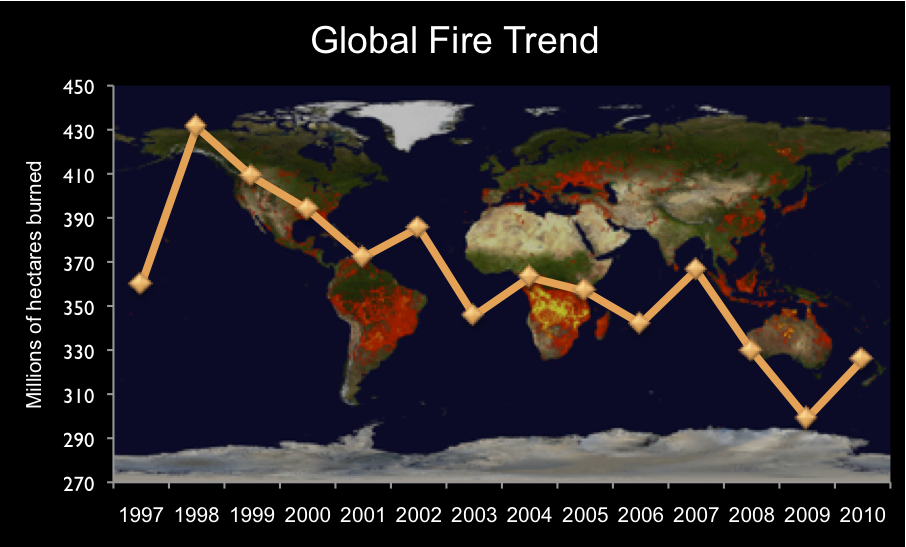
Still, Giglio and his colleagues have pieced together hints of trends that are worth noting. Between 1997 and 2008, they show that the number of hectares burned across the globe has declined a significant amount from a maximum in 1998 to a minimum in 2008 (see graph above). The area burned in the United States, which is less than a percent of the total area burned each year, has seen peaks in 2000 and 2007.

What’s driving the global decline in area burned? The topic is ripe for more research, but when I asked Giglio that question he reminded me that, contrary to what one might expect, increasing global temperatures and drought do not invariably produce increases in fire activity.
4:11 PM | 0 comments | Read More

Earth Picture of the Day

Written By admin on Wednesday, September 14, 2011 | 10:36 AM

Nature Wallpaper


10:36 AM | 0 comments | Read More

The Brightness of the Sun


The bright sun, a portion of the International Space Station and Earth's horizon are featured in this image photographed during the STS-134 mission's fourth spacewalk in May 2011. The image was taken using a fish-eye lens attached to an electronic still camera.
9:46 AM | 0 comments | Read More

New Planet Discovered

Written By admin on Tuesday, September 13, 2011 | 1:00 PM


Image above: These time-lapse images of a newfound planet in our solar system, called 2003UB313, were taken on Oct. 21, 2003, using the Samuel Oschin Telescope at the Palomar Observatory near San Diego, Calif. The planet, circled in white, is seen moving across a field of stars. The three images were taken about 90 minutes apart.


Scientists did not discover that the object in these pictures was a planet until Jan. 8, 2005. Image credit: Samuel Oschin Telescope, Palomar Observatory


Image above: This artist's concept shows the planet catalogued as 2003UB313 at the lonely outer fringes of our solar system. Our Sun can be seen in the distance. The new planet, which is yet to be formally named, is at least as big as Pluto and about three times farther away from the Sun than Pluto. It is very cold and dark.
1:00 PM | 0 comments | Read More

Our Planet and Sun

Written By Admin on Thursday, January 27, 2011 | 4:34 AM

What causes the sun to vary? 

our earthWe live in the extended atmosphere of a magnetic variable star that drives our solar system and sustains life on Earth. Our Sun varies in every way we can observe it. The Sun gives off light in the infrared, visible, ultraviolet, and at x-ray energies, and it gives off magnetic field, bulk plasma (the solar wind) and energetic particles moving up to nearly the speed of light, and all of these emissions vary. These variations occur on timescales from milliseconds to billions of years. Most of these variations are related to the solar magnetic field, which is caused by the moving plasma inside the rotating Sun, which make a dynamo. 

How do the Earth and Heliosphere respond?

Our planet is immersed in this seemingly invisible yet exotic and inherently dangerous environment. Above the protective cocoon of Earth’s lower atmosphere is a plasma soup composed of electrified and magnetized matter entwined with penetrating radiation and energetic particles. The Earth’s magnetic field interacts with the Sun’s outer atmosphere to create this extraordinary environment.

Our Sun’s explosive energy output forms an immense, complex magnetic fields structure. Hugely inflated by the solar wind, this colossal bubble of magnetism known as the heliosphere stretches far beyond the orbit of Pluto, from where it controls the entry of cosmic rays into the solar system. On its way through the Milky Way this extended atmosphere of the Sun affects all planetary bodies in the solar system. It is itself influenced by slowly changing interstellar conditions that in turn can affect Earth’s habitability. In fact, the Sun’s extended atmosphere drives some of the greatest changes in the near-Earth space environment affecting our magnetosphere, atmosphere, ionosphere, and potentially our climate.

What are the impacts on humanity?

Modern society depends heavily on a variety of technologies that are susceptible to the extremes of space weather — severe disturbances of the upper atmosphere and of the near-Earth space environment that are driven by the magnetic activity of the Sun. Strong electrical currents driven in the Earth’s surface during auroral events can disrupt and damage modern electric power grids and may contribute to the corrosion of oil and gas pipelines. Changes in the ionosphere during geomagnetic storms driven by magnetic activity of the Sun interfere with high-frequency radio communications and GPS navigation. During polar cap absorption events caused by solar protons, radio communications can be severely compromised for commercial airliners on transpolar crossing routes. Exposure of spacecraft to energetic particles during solar energetic particle events and radiation belt enhancements can cause temporary operational anomalies, damage critical electronics, degrade solar arrays, and blind optical systems such as imagers and star trackers used on commercial and government satellites.

Harsh conditions in the space environment also pose significant risks for the journey of exploration. Although space is a near-vacuum, the very-thinly-spread particles and fields are like an ocean that can affect the spacecraft and astronauts that travel through it. Like seafaring voyagers, space explorers must be constantly aware of the current space weather and be prepared to handle the most extreme conditions that might be encountered.
4:34 AM | 0 comments | Read More

How will the Earth system change in the future?

Written By Admin on Monday, January 17, 2011 | 2:27 AM

As the world consumes ever more fossil fuel energy, greenhouse gas concentrations will continue to rise and Earth's average temperature will rise with them. The Intergovernmental Panel on Climate Change (or IPCC) estimates that Earth's average surface temperature could rise between 2°C and 6°C by the end of the 21st century. 


For most places, global warming will result in more hot days and fewer cool days, with the greatest warming happening over land. Longer, more intense heat waves will happen more often. High latitudes and generally wet places will tend to receive more rainfall, while tropical regions and generally dry places will probably receive less rain. Increases in rainfall will come in the form of bigger, wetter storms, rather than in the form of more rainy days. In between those larger storms will be longer periods of light or no rain, so the frequency and severity of drought will increase. Hurricanes will likely increase in intensity due to warmer ocean surface temperatures. So one of the most obvious impacts of global warming will be changes in both average and extreme temperature and precipitation events. 

Scientists are also monitoring the great ice sheets on Greenland and West Antarctica, both of which are experiencing increasing melting trends as surface temperatures are rising faster in those parts of the world than anywhere else. Each of those ice sheets contains enough water to raise sea level by 5 meters and if our world continues to warm at the rate it is today then it is a question of when, not if, those ice sheets will collapse. Some scientists warn we could lose either, or both, of them as soon as the year 2100. 

Ecosystems will shift as those plants and animals that adapt the quickest will move into new areas to compete with the currently established species. Those species that cannot adapt quickly enough will face extinction. Scientists note with increasing concern the 21st century could see one of the greatest periods of mass extinction of species in Earth's entire history. Ultimately, global warming will impact life on Earth in many ways. But the extent of the change is up to us.
2:27 AM | 0 comments | Read More

How is the global earth system changing?

Written By Admin on Saturday, January 15, 2011 | 1:00 AM

Earth is currently in a period of warming. Over the last century, Earth's average temperature rose about 1.1°F (0.6°C). In the last two decades, the rate of our world's warming accelerated and scientists predict that the globe will continue to warm over the course of the 21st century. Is this warming trend a reason for concern? After all, our world has witnessed extreme warm periods before, such as during the time of the dinosaurs. Earth has also seen numerous ice ages on roughly 11,000-year cycles for at least the last million years. So, change is perhaps the only constant in Earth's 4.5-billion-year history.

Scientists note that there are two new and different twists to today's changing climate: (1) The globe is warming at a faster rate than it ever has before; and (2) Humans are the main reason Earth is warming. Since the industrial revolution, which began in the mid-1800s, humans have attained the magnitude of a geological force in terms of our ability change Earth's environment and impact its climate system.

Since 1900, human population doubled and then double again. Today more than 6.5 billion people inhabit our world. By burning increasing amounts of coal and oil, we drove up carbon dioxide levels in the atmosphere by 30 percent. Carbon dioxide is a "greenhouse gas" that traps warmth near the surface.

Humans are also affecting Earth's climate system in other ways. For example, we transformed roughly 40 percent of Earth's habitable land surface to make way for our crop fields, cities, roads, livestock pastures, etc. We also released particulate pollution (called "aerosols") into the atmosphere. Changing the surface and introducing aerosols into the atmosphere can both increase and reduce cloud cover. Thus, in addition to driving up average global temperature, humans are also influencing rainfall and drought patterns around the world. While scientists have solid evidence of such human influence, more data and research are needed to better understand and quantify our impact on our world's climate system.
1:00 AM | 0 comments | Read More

Theorize Final Growth Spurt for Planets

Written By Admin on Saturday, December 11, 2010 | 3:50 PM

A team of NASA-funded researchers has unveiled a new theory that contends planets gained the final portions of their mass from a limited number of large comet or asteroid impacts more than 4.5 billion years ago. These impacts added less than one percent of the planets' mass.

Scientists hope the research not only will provide a better historical picture of the birth and evolution of Earth, the moon and Mars, but also allow researchers to better explore what happened in our solar system's beginning and middle stages of planet formation.

“No one has a model of precisely what happened at the end of planet formation—we’ve had a broad idea—but variables such as impactor size, the approximate timing of the impacts, and how they affect the evolution of the planets are unknown,” said William Bottke, principal investigator from the Southwest Research Institute (SWRI) in Boulder, Colo. “This research hopefully provides better insights into the early stages of planet formation.”

The team used numerical models, lunar samples returned by Apollo astronauts and meteorites believed to be from Mars to develop its findings. The scientists examined the abundances of elements such as gold and platinum in the mantles, or layers beneath the crust, of Earth, the moon and Mars. Consistent with previous studies, they concluded the elements were added by a process called late accretion during a planet's final growth spurt.

"These impactors probably represent the largest objects to hit Earth since the giant impact that formed our moon," Bottke said. “They also may be responsible for the accessible abundance of gold, platinum, palladium, and other important metals used by our society today in items ranging from jewelry to our cars’ catalytic convertors.”

The results indicate the largest Earth impactor was between 1,500 - 2,000 miles in diameter, roughly the size of Pluto. Because it is smaller than Earth, the moon avoided such enormous projectiles and was only hit by impactors 150 - 200 miles wide. These impacts may have played important roles in the evolution of both worlds. For example, the projectiles that struck Earth may have modified the orientation of its spin axis by 10 degrees, while those that hit the moon may have delivered water to its mantle.

"Keep in mind that while the idea the Earth-moon system owes its existence to a single, random event was initially viewed as radical, it is now believed that large impacts were commonplace during the final stages of planet formation,’ Bottke said. “Our new results provide additional evidence that the effects of large impacts did not end with the moon-forming event."

The paper, "Stochastic Late Accretion to the Earth, Moon, and Mars," was published in the Dec. 9 issue of Science. It was written by Bottke and David Nesvorny of SWRI; Richard J. Walker of the University of Maryland; James Day of the University of Maryland and Scripps Institution of Oceanography, University of California, San Diego; and Linda Elkins-Tanton of the Massachusetts Institute of Technology. The research is funded by the NASA Lunar Science Institute (NLSI) at the agency's Ames Research Center in Moffett Field, Calif.

The NLSI is a virtual organization that enables collaborative, interdisciplinary research in support of NASA lunar science programs. The institute uses technology to bring scientists together around the world and comprises competitively selected U.S. teams and several international partners. NASA's Science Mission Directorate and the Exploration Systems Mission Directorate at the agency's Headquarters in Washington, funds the institute, which is managed by a central office at Ames.

For more information on NLSI, visit: http://www.nasa.gov/


3:50 PM | 0 comments | Read More

Faster Flood Forecasting at SERVIR-Africa

Written By Admin on Wednesday, November 10, 2010 | 10:49 PM


In September 2010, SERVIR Science Coordinator Dr. Ashutosh Limaye made his first journey to the SERVIR-Africa node at the Regional Center for Mapping of Resources for Development, or RCMRD, in Nairobi, Kenya.

In this part of the world, flood estimation is a hot topic. Limaye's discussions with the RCMRD team and stakeholders from the Kenya Meteorological Department and USAID’s Famine Early Warning Systems Network highlighted the importance of flood-potential mapping, flood forecasting and post-event flood mapping for the region.

A hydrologist by training, Limaye is attuned to the economic and public health ramifications of better hydrologic estimation in East Africa. "Rift Valley Fever is critical in that part of the world, where livestock transport and the livelihood of a vast population come to a grinding halt because of travel restrictions induced by the disease," he said.

Without a doubt, he said, improved stream flow and flood estimation can have multiple important applications in the SERVIR-Africa region, including flood and drought disaster forecasting and response; agricultural and food security impacts; and Rift Valley Fever risk mapping, to name just a few.

In response to these needs, SERVIR-Africa and the Kenya Meteorological Department are teaming to give decision-makers flood forecasts with longer lead-times. SERVIR-Africa has investigated various regional and global hydrologic models for flood modeling, which shows scientists where standing water will occur above a defined threshold. A team at NASA's Goddard Space Flight Center in Greenbelt, Md., and the University of Oklahoma in Norman pioneered the hydrologic modeling efforts in East Africa for SERVIR-Africa. They developed the hydrologic model based on the state-of-the-art Variable Infiltration Capacity model.

Limaye is enhancing those efforts by incorporating forecast components into the modeling system. For example, in the Nzoia watershed in Lake Victoria Basin, SERVIR-Africa is working with researchers at Goddard, Oklahoma University and NASA’s Marshall Space Flight Center in Huntsville, Ala., to implement and evaluate a higher resolution (approximately 1 km) distributed hydrologic model: the Coupled Routing and Excess Storage, or CREST, water balance model. In Lake Victoria Basin, the CREST model uses real-time rainfall data from the Tropical Rainfall Measuring Mission satellite as a boundary condition to map streamflow, evapotranspiration and soil moisture.

For flood forecasting, SERVIR-Africa is working with the Kenya Meteorological Department to incorporate their atmospheric model-based rain forecasts into the CREST model in place of observed Tropical Rainfall Measuring Mission data.

These rain forecasts will give decision-makers a longer lead time for flood forecasting, allowing more time for preparation and reaction. These forecasts will be available through the SERVIR-Africa website.

The SERVIR program is operated by the Earth Science Division's Applied Sciences Program in NASA's Science Mission Directorate in Washington. Three other NASA field centers work with Marshall and Goddard on the program: NASA's Ames Research Center in Moffet Field, Calif., NASA's Jet Propulsion Laboratory in Pasadena, Calif., and NASA's Langley Research Center in Hampton, Va. 

10:49 PM | 0 comments | Read More

Root of the Matter: A New Map Shows Life-Saving Forests’ Scarcity Defies Past Estimates

Countless people clung to life in the branches of trees hemming the shorelines during the deadly 2004 tsunami that killed more than 230,000 coastal residents in Indonesia, India, Thailand and Sri Lanka. In the aftermath of the disaster, land change scientist Chandra Giri from the U.S. Geological Survey (USGS) decided to explore to what degree those unique trees – which make up valuable forest ecosystems called mangroves -- safeguard lives, property and beaches during hurricanes, tsunamis and floods.

Encountering challenges while trying to quantify the long-standing hypothesis compelled Giri and an international team of scientists to take a more roundabout and ultimately more viable research path: to first describe the distribution and magnitude of the area mangrove ecosystems cover. With funding from NASA, that path yielded the first high-resolution, satellite-based global map of mangrove forests. Published online this summer in the Journal of Global Ecology and Biogeography, the map revealed worrisome facts about these treasure troves for biodiversity: they make up less of the Earth’s surface than previously thought. This new information, Giri says, coupled with other reports that mangrove forests are vanishing faster than scientists' previous estimates, can provide motivation and evidence for stronger conservation efforts.

Recently Giri was interviewed about his research from his office in Sioux Falls, S.D.

Why were mangroves important as a focus of your initial study, and why did you change gears to a great degree from your initial approach?

Like others around the world, I watched TV news reports six years ago showing lives and property saved by mangroves during the tsunami. I had an epiphany; these trees really do have a role to play as a protective barrier against some natural disasters, and just maybe the extent of that role can be measured in some way.

We knew that mangroves are extremely precious as a robust habitat, refuge and food source for hundreds of wildlife species as well as for humans. And they store a disproportionately greater amount of terrestrial carbon than a lot of other ecosystems. They’re clearly an important ecosystem when it comes to biodiversity. But no one has systematically assessed the forests as disaster protection with hard data at a broader scale.

Doing so posed challenges we hadn’t anticipated. Proving scientifically that mangrove forests can protect lives and property requires a hard look at factors like socioeconomic data, local topography, mangrove health, and the distance between forests and villages that are considered “hotspots” for extreme weather events. Some data for the tsunami impacted countries in Asia is readily available, while some isn’t.

The challenges slowed us down, but forced us to look for different means of gathering data and new angles from which to analyze mangroves.

How much of the Earth’s surface is covered by mangrove forests, and how do you know they are disappearing more rapidly than scientists expected?

Our new map suggests that mangroves cover about 53,190 square miles of the surface of the planet. That’s about 12 percent less than scientists estimated in previous studies! That’s troubling when combined with the growing concern that, according to the International Union for the Conservation of Nature, 16 percent of mangrove species are in danger of extinction, and, according to the Millennium Ecosystem Assessment, a whopping 35 percent of mangrove ecosystems disappeared between 1980 and 2000. That decline is mostly due to agricultural expansion, urban development and shrimp farming.

Specifically, the map reveals seventy-five percent of the forests are concentrated in only 15 countries, with the rest scattered across the globe more sparsely. We found that 118 countries are home to mangroves, with most in Asia and Africa (42 percent and 21 percent, respectively), 15 percent in North America and Central America, 12 percent spread across the Pacific islands, and 11 percent in South America.

Can you explain why yours is the first satellite-derived map of the world’s mangroves, even though satellite monitoring of Earth has been pretty advanced for years?

Previously, mangroves were not mapped by global land cover initiatives because they used resolutions that just weren't fine enough across small geographical areas, and Landsat satellite mapping was expensive and cumbersome. For years Landsat data was about $250 or more for an image.

Extensive image collections were off limits for a lot of scientists who depended on external research funding for their work. Our eventual map required more than 1,000 satellite images, a price tag that would have been at least $250,000.

That all changed about three years ago, when Global Land Survey data were made available and USGS made Landsat data free for the first time. At the same time, computing facilities have improved so that we can now handle large volumes of data. This opened a new door for us into approaching our scientific analysis of mangroves from another perspective – from space, by way of highly detailed satellite images.

This advancement is arguably an improvement over alternative estimates of mangroves. For example, the United Nations (UN)has generated higher estimates but they’re partly based on responses to a questionnaire to each country asking how many mangrove forests they have. Country responses are all over the map, so to speak.

Creating a global map of any aspect of the Earth’s surface sounds like a painstaking process. What steps did you take to create the mangrove map?

Mangroves are largely identifiable in false-color Landsat images – appearing distinctly in a shade of dark red near a shoreline or adjacent to a body of water that sets them apart from other types of land surfaces. We used that shade as the signature for the presence of mangroves in the images.

Satellites capture imagery of Earth with varying degrees of resolution, similar to pixel sizes on a television screen. In past years, scientists have typically viewed global land cover in individual pixels, or snapshots, spanning 1 square kilometer (.62 square miles) in area. There’s not sufficient enough detail visible at that resolution to detect mangroves. Our technique involves use of data at a finer resolution – each picture is an area that’s just 30 square meters (32 square yards) – making it easy to classify mangroves’ that are often found in small patches.

We invited scientists from South America, Africa, India, and Asia – who stayed at our facility here in Sioux Falls up to 6 months each during our project period between 2007 and 2009 – to use our methodology to pore over and analyze the Landsat image data to help slowly piece together the mangrove map. To validate what we saw in images as mangrove forests, our team also collected and used field data, news reports, scientific publications, and Google images of each region.

Does the new map and estimates of mangroves bring you and other scientists closer to understanding the significance of mangroves as protective barriers against extreme weather events like tsunamis?

This has been a stepping stone to looking back at our original question. We have to first know where mangroves exist, their density, and more about their rate of change to do the additional legwork regarding their protective role. We would have otherwise been putting the cart before the horse.

We know the Asia-Pacific region, Indonesia in particular, has the most mangrove forests. From UN and other reports, we also know Asia is the region most at risk from deadly natural disasters like the tsunami. So, we’re better positioned to investigate mangroves’ value as armor against them, and to help substantiate conservation efforts in the region to stem the forests’ decline.

We also expect scientists to pair our Landsat-based estimates with other remote sensing measurements in the future like lidar, to estimate height and biomass of mangroves to generate more precise estimates of mangrove conditions.
 
NASA’s Earth Science News
10:18 AM | 0 comments | Read More

Save Our Earth

Written By Admin on Wednesday, November 3, 2010 | 12:12 AM


The Blue Planet

Earth (or the Earth) is the third planet from the Sun, and the densest and fifth-largest of the eight planets in the Solar System. It is also the largest of the Solar System's four terrestrial planets. It is sometimes referred to as the World, the Blue Planet, or by its Latin name,
Home to millions of species including humans, Earth is currently the only place where life is known to exist. The planet formed 4.54 billion years ago, and life appeared on its surface within a billion years. Earth's biosphere has significantly altered the atmosphere and other abiotic conditions on the planet, enabling the proliferation of aerobic organisms as well as the formation of the ozone layer which, together with Earth's magnetic field, blocks harmful solar radiation, permitting life on land. The physical properties of the Earth, as well as its geological history and orbit, have allowed life to persist during this period. The planet is expected to continue supporting life for at least another 500 million years.
Our planet is the third planet from the Sun and the fifth largest of the eight planets in our Solar System. It is located between Mars and Venus, which are also terrestrial planets. Earth has a number of nicknames including the Blue Planet and Terra. The most remarkable thing about our planet is the life that thrives all over our planet. Not only are there plants, but there are also animals, sea creatures, birds, and other diverse species.
Scientists have often tried to discover what makes earth such an ideal place for sustaining life. The Earth has been described as being in the habitable zone, which is a theoretical area in a Solar System where the conditions are optimal for the existence of life. Scientists are using the habitable zone to find extrasolar planets that may be able to support life. Earth is also the only planet in our Solar System with tectonic plates. The plate tectonics help protect our planet from overheating like Venus because the carbon in plants makes its way back into the Earth and is recycled. Liquid water is also an important element for life. Just over 70% of Earth’s surface area is water.
Our planet’s atmosphere helps keep heat trapped around the planet as well as protects us from the vacuum of space. The atmosphere is comprised of a variety of chemicals. It is mostly nitrogen (77%) and oxygen (21%). It also contains small amounts of water, carbon dioxide, argon, and other substances.
Earth is the densest planet in the Solar System, with an average density of approximately 5520 kg/m 3, which is more than five times the density of water. The planet is so dense because it is composed of large amounts of iron. Most of the iron is concentrated in the core which is 88% iron. Because the planet is so dense, its gravity is great compared to its size. The temperature on our planet is not as extreme as the temperature of the other planets. The lowest recorded temperature on Earth is approximately -89°C in Antarctica while the highest recorded temperature is 58°C.  The diameter of the planet is 12,742 kilometers, and the volume is 1,080,000,000,000 km3. The planet is not a perfect sphere. It is actually an oblate spheroid. That means it is squished at the poles, so it bulges out at the equator. This is caused by the speed of the Earth’s rotation and is common with all the planets.

12:12 AM | 0 comments | Read More

Hurricane

Written By Admin on Saturday, October 16, 2010 | 9:00 AM

In 2010, there were 14 named storms, of which 7 were hurricanes and 5 were major hurricanes (that is, category-3, 4 and 5 ones). Hurricane activity this year was about 1.5 times the median hurricane activity level.A hurricane is an intense tropical storm. Tropical storms form over warm tropical oceans when local sea surface temperatures are above 26.5°C (80°F) through a depth of at least 50 meters (160 ft). Under these conditions, evaporation from the ocean surface creates very high humidity in the atmosphere, which in turn generates thunderstorms.

A surefire way to kill a hurricane? Add something called “vertical wind shear” — essentially a change in wind speed and direction with height. It stops the storm from forming in its tracks by ripping it apart.  Another way to kill a hurricane? Whip up a wind across the deserts of northern Africa. Dust gets swept up into the air and helps damp down developing storms. (In fact, it’s the effect of the dust combined with vertical wind shear and super-dry air that’s the killer.)

There’s a school of thought that says that climate change should fuel more hurricanes and more intense ones, because as the planet warms, ocean waters warm and sea surface temperature rises.
In a paper published earlier this year in Science, Thomas R. Knutson, of the Geophysical Fluid Dynamics Laboratory at the National Oceanic and Atmospheric Administration (NOAA) and co-authors suggest that we should expect an increase in the frequency of the strongest hurricanes in the Atlantic, roughly by a factor of two by the end of the century, despite a decrease in the overall number of hurricanes. “But we should not expect this trend to be clearly detectable until we near the end of the century, given a scenario in which CO2 [carbon dioxide] doubles by 2100.” The relationship will become more apparent as we improve our understanding and data and as the climate continues to warm.

9:00 AM | 0 comments | Read More